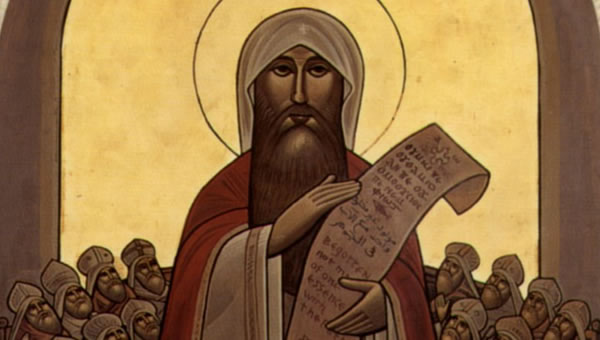
Athanasian Creed on the Trinity
In the old Divine Office, all of us priests pray during the morning hour called "Prime" the Symbolum Athanasium or Athanasian Creed on Trinity Sunday. (It is prayed even more frequently in ancient editions preceding the 1960 Roman Breviary.) The Creed below is attributed to St. Athanasius of Alexandria in the 4th century, written to distinguish true Catholic-Christians (from Arians who denied the Divinity of Christ.) This Creed on the Father, Son and Holy Spirit begins with the unusual and striking words, "Whosoever wills to be saved..."(Quicúmque vult salvus esse) "before all things it is necessary that he hold the Catholic faith." This is followed by an astonishingly beautiful and powerful treatise on [...]
Can a Priest Baptize the Baby of a Same-Sex Couple?
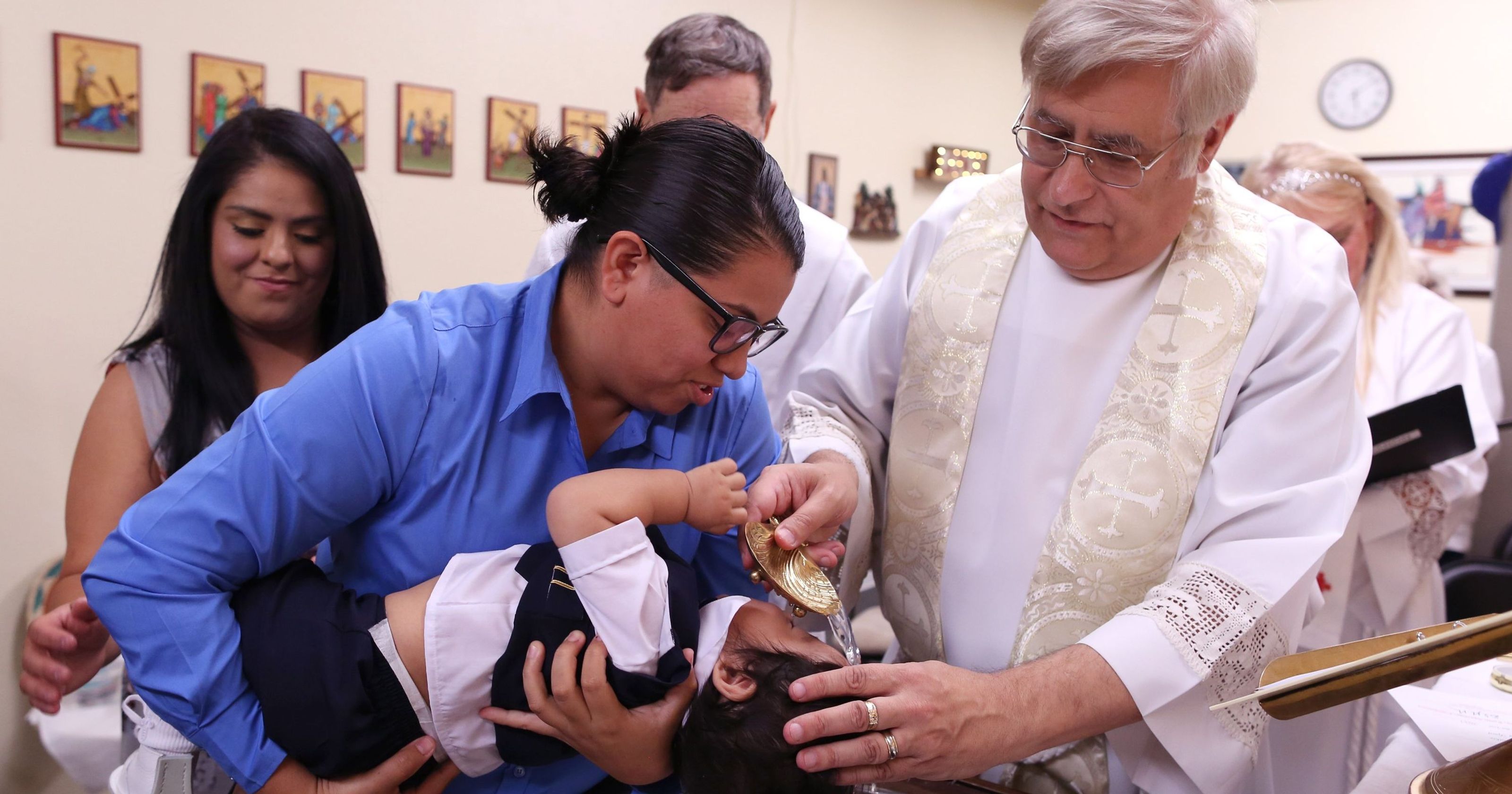
In the photo above, a priest baptizes a baby that will be raised by two women. This took place at St. Cecilia’s in California on 7 May 2017. P/C USA Today’s Desert Sun. When a large homeschooling family brings their 9th baby to be baptized, that infant, at the moment of baptism, dies to the original sin in which it was born, comes out of the water risen with Jesus Christ and is a tabernacle of the Blessed Trinity, now beginning life as a son or daughter of God. When two same-sex guardians bring an infant to be baptized, that infant, at the moment of baptism, dies to the original [...]
World Religions Part III: Real Catholicism is the Only Antidote to Chaos
I attempted to prove in World Religions part I and part II that Catholicism is the only world religion that even claims to deliver lasting fulfillment to modern man. In this blog post, I will attempt to show that an "updated" Catholicism can never do this. Only real Catholicism can serve as "an antidote to chaos" to borrow a term from the best-selling book by Jordan Peterson. Yesterday, I drove from Denver to Chicagoland to be with my grandma for what may be her last month on earth. I am vigiling by her bed with both an iPad to get some work done and the old Collectio Rituum to begin [...]
World Religions Part II: The Exclusive, All-Embracing Cross
Because this blog post will inevitably raise the question "Who can be saved?" I would like to give the two bookends within which all Catholic orthodox answers must fall. One the one end, Pope Pius IX wrote, "By Faith it is to be firmly held that outside the Apostolic Roman Church none can achieve salvation. This is the only ark of salvation. He who does not enter into it, will perish in the flood. Nevertheless equally certainly it is to be held that those who suffer from invincible ignorance of the true religion, are not, for this reason, guilty in the eyes of the Lord." (Denzinger 1647, Ott 312.) Invincible [...]

Harry Potter’s Effects on Children
I recently put up a FB post about JK Rowling's fictional character Cassandra Vablatsky. Vablatsky is the fictional character who wrote the textbook Hogwarts School of Witchcraft and Wizardry as mentioned in Harry Potter and the Prisoner of Azkaban. Even Harry Potter's "fandom" website admits that Vablatsky was named after famous Russian Satanist, Helena Blavatsky. Under this FB post, I had 223 comments before publication of this blog post. One thing I later remarked is that it would be harder to pry from the hands of a Colorado teen his or her pot than Harry Potter novels! Such a disproportionate response shows some preternatural involvement. But what proves the preternatural (diabolical) side [...]

World Religions Part I: Three Options
CS Lewis once wrote, “Religion is man’s search for God, but Christianity is God’s search for man.” Whereas Divine Revelation only allows for one true religion, I believe that all of the current religions of the world can be boiled down to only three sustainable philosophies. Or, at least I believe that only three world philosophies could possibly coordinate to the desires of a post-modern man. Epicureanism is to live for pleasure, but the original Greek promoter of hedonism, Epicurus (4th century BC), was more like an LA pot-smoker than a fast-paced NYC coke addict (something we usually think of when we think of the word “hedonism.”) This is because [...]
Pro Divine Mercy From a Rad-Trad
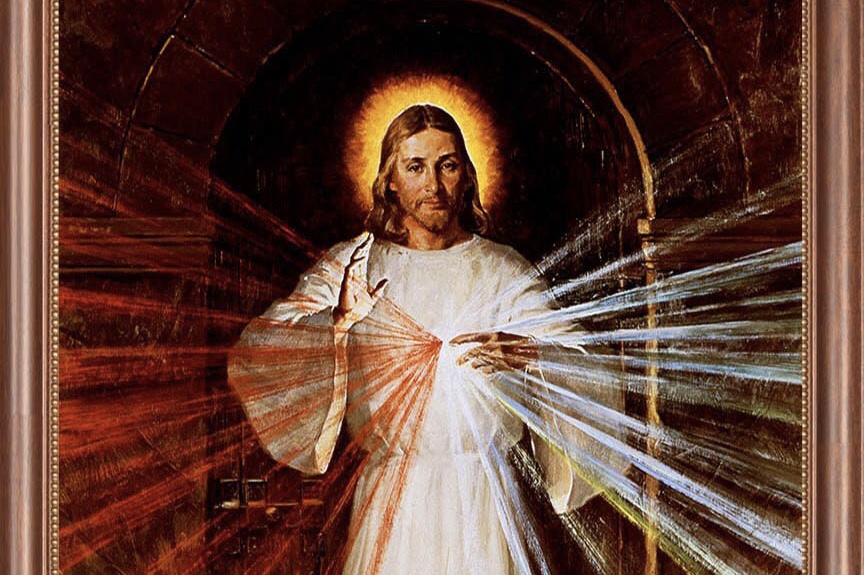
Most "EWTN Catholics” (for lack of a better term) might be surprised to find that in the Traditional Latin Mass (TLM) world, there is sharp divide down the middle between those who believe that the private revelations of Sr. Faustina Kowalska are authentic, versus those who do not. I am referring to the Divine Mercy Diary, a book of private revelation written by a Polish nun in the 1930s. A modern EWTN Catholic could, in an overly-facile manner, condemn traditionalists who are wary of the Divine Mercy message for just being “Jansenist” or “disobedient.” This would be too easy and not fair. Indeed, one must realize that many traditionalists [...]

Why You Should Say No to Being an Organ-Donor
Edit: USA Today wrote a very important article following my blog post called Death by Donation: Euthanizing Patients for Organs. Although I am a Catholic priest, I am also an ex-paramedic and I graduated pre-health from Boston College. I am writing this blog post “Why you should say no to organ donation on your driver’s license” as a former paramedic, not as a priest. In other words, this blog post will be practical medical advice for all readers Catholic or non-Catholic. There will be no overt Catholic bioethics below, except these two sentences: The Catholic Church has no problem with organ donation per-se. The problem is that certain organs are [...]
Did Christ Program the Church to Withstand Every Storm?
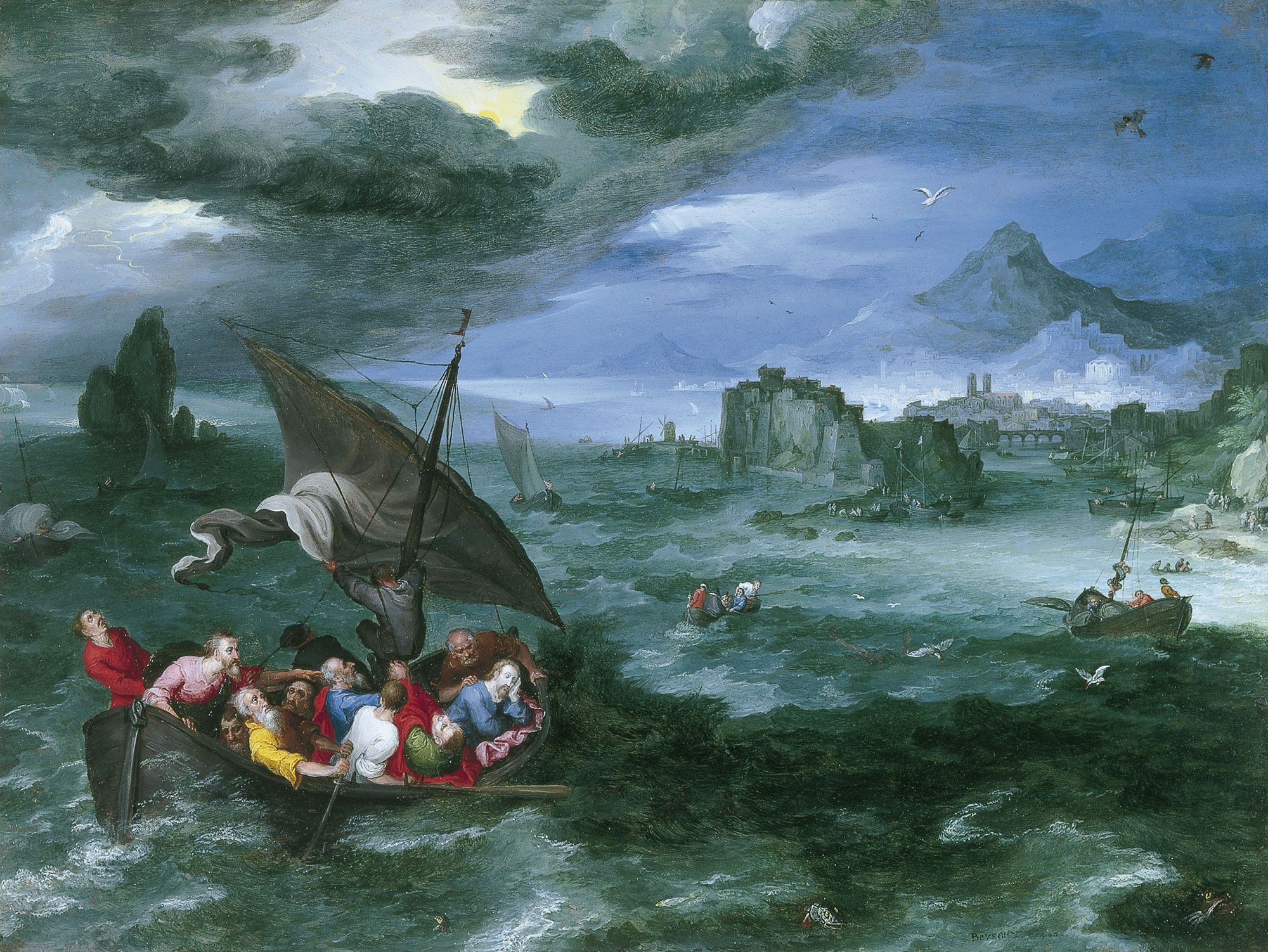
Between my initial conversion as a teenager (1997) and about halfway through my nine-years of priesthood (2014) I would probably have been described as a small-fish but bold-agent in the "New Evangelization" of Pope John Paul II. I don't regret those days. I came to know salvation-history through great lay leaders. I saw real miracles in the charismatic movement (as well as some evil things.) As a layman, I had many sins forgiven by priests who did not speak a word of Latin (and some invalid confessions via priests changing the words of absolution.) As much as this blog post might sound primed for a line like "But now I [...]

Why are Trads So Mean to Each Other?
And then many will fall away and betray one another and hate one another. And many false prophets will arise and lead many astray. And because lawlessness will be increased, the love of many will grow cold. But the one who endures to the end will be saved. And this gospel of the kingdom will be proclaimed throughout the whole world as a testimony to all nations, and then the end will come.—Jesus Christ in St. Matthew 24:10-14 Why are traditional Catholics so mean to each other? I don’t mean people like Virginia senator Tim Kaine who described himself as a “traditional Catholic.” By “traditional Catholic” I mean people who [...]