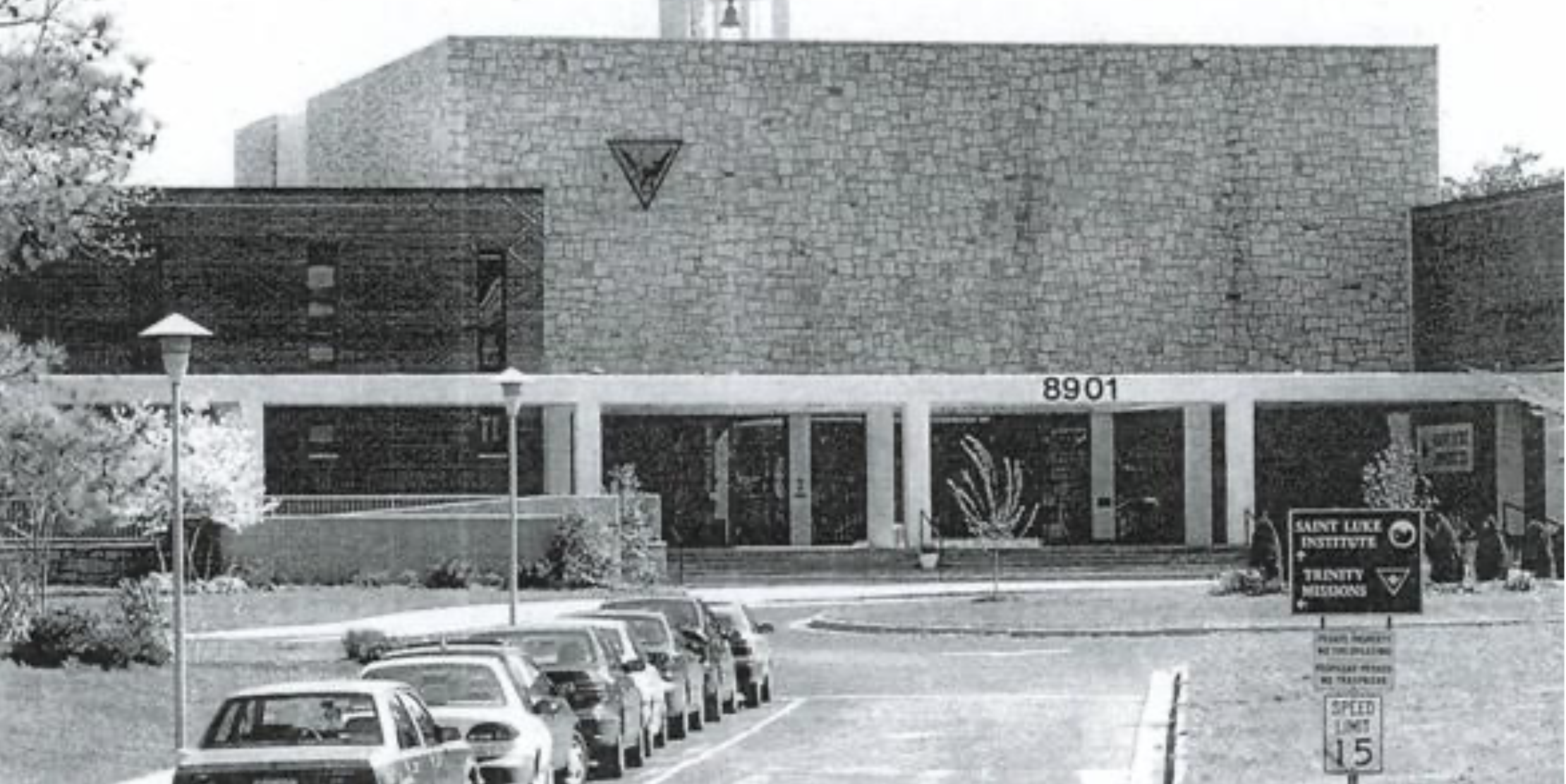
p/c Globe photo/Lisa Kay, St. Luke Institute, Silver Spring, MD.
Some priests were sent by their bishop to the funny-farm to heal them. Others were sent there to break them of their intransigent orthodoxy.
By now, most American Catholics who are at least 30 years old know of one Catholic priest (or two) who has been sent away for “treatment” by the diocese. If the priest was liked by the parish, most of the faithful remained hush-hush about why he got sent packing. If he was a distrusted priest, well, lay-lips might be a little looser: Was Father sent away for alcoholism? Did he have a girlfriend? Did he have a boyfriend? Did he harm a child? Maybe he just reached a point of burnout and needed a break…
The world of behavioral care centers or psychological care centers for priests is a mysterious world for most lay Catholics. The 2015 movie Spotlight starring Michael Keaton opened up a bit more on this front. The movie covered the true story of the Boston Globe “Spotlight” section which released the names of priests across the Archdiocese of Boston who had molested children for decades. Many of them were sent to such a psych unit, but only until being recycled back into active ministry.
One of the crescendos in the movie Spotlight was when a Globe reporter goes deep into the written annals of the Archdiocese of Boston to discover that “a medical sabbatical” was simply code for “priest took a break after molesting a child.” Such priests were indeed sent to psych units, but only for a limited time, as I mentioned above. After a year of “sabbatical,” the criminal was often put back into active ministry by Cardinal Law.
This movie wasn’t just another flick revealing an anti-Catholic bias (as I once desired to believe.) These horrible acts of abuse really happened in Boston, and Cardinal Law truly shuffled around predators parish-to-parish for a long time. (I lived across the street from Cardinal Law from 1996 to 2000 while studying pre-med and Boston College, my alma, so it hits close to home. I even met him.)
Before getting to the meat and potatoes of this article, I want to put two seemingly-unrelated things on the back burner here:
1) St. Augustine said, There are two things that kill the soul: despair and false hope.—Sermon 87. At this point, I could unfortunately make that the unofficial motto of my website. You see, it’s not that I desire to squash the little hope that lay Catholics still have in the hierarchy. It’s that I really believe in the words of St. Augustine seen above. Notice that St. Augustine didn’t write “False hope is a decent counterfeit until you obtain real hope.” He said “false hope kills the soul.” It kills the soul. That is a really big deal. You are going to see why this applies to being a realist when I write a little later in this article about good conservative men joining mainstream seminaries.
2) I know my website frequently delineates between conservative and traditional priests. I usually say they are not the same. I stick by that assertion in most my articles. But today, I am going to lob both conservative and traditional diocesan Catholic priests of the United States into one category: orthodox and faithful priests. This is because we are going to look at the fact that two types of priests usually get sent away for treatment: Those who have a perverse addiction and those who need a re-education camp for being too orthodox.
That latter category of good priests getting sent to the monkey-house generally includes both conservative and traditional priests. Notice above, I put usually in bold and italics because there are exceptions to those two categories. On extremely rare occasions, there might even be overlap. But hard cases make bad law for an article with limited space.
Let’s zoom out a bit now and ask a more general question before we enter the priest funny-farm: What happens to most conservative American Catholic seminarians before and after ordination? Here’s my rough estimate after visiting all 50 states:
- 70% compromise on their conscience on issues of dogma or liturgy under pretext of obedience “to the pastor and bishop.” This is from the time of their first month in seminary to, say, ten years after ordination.
- 5% of those men who do not compromise get sent to a rural parish if they were not first washed out of the seminary or in their first two years as a priest.
- 5% of the non-compromise guys eventually switch to another diocese or the Archdiocese for Military Services or a traditional Society of Apostolic life or a conservative religious congregation.
- 5% of the more intractably solid men get suspended for their orthodoxy (usually hung by the bishop on a red-herring like “financial malfeasance in the parish.”)
- 5% quit the priesthood and get laicized by their own volition, especially after too much pressure and loneliness.
- 5% stay actually orthodox and by some miracle (or blackmail) remain in active ministry in their home diocese.
- 5% of those not compromising get sent to a psych unit to break them and laicize them.
I promise you: No AI has ever been used in any of my articles. This is all from experience. The above is simply my best guess, not perfect statistics.
Again, those numbers refer only to the conservative men who entered seminary. Most get washed out in seminary. Notice that by my estimate above, only 5% of the men who initially entered seminary are fully orthodox by the time they make it to their, say, ten-year anniversary of ordination as a Catholic priest. Why? Because the system of modernism simply cannot support Apostolic Catholicism. It’s absolutely impossible because we’re talking about two different religions.
That is why I do not get pumped about all the new Catholic articles claiming “Young seminarians are sooooo conservative.” Yep. They are conservative. Just like the boomers who entered under JPII and are now lukewarm—at best. The modernist hierarchy inevitably brainwashes 95% of them away from orthodoxy. Look again at the bullet points above and check them with an old conservative priest in your diocese if you doubt me.
But by “conservative,” I don’t mean your priest gives a pro-life sermon twice a year. I mean he teaches couples using contraception will go to hell if they don’t repent. Of course, any priest like that is usually removed by even putatively-conservative bishops. If he’s still there preaching, God bless him. (But ask him who he has dirt on in the chancery to not lose his job as pastor or parish-priest.)
As far as that last bullet point way above, let’s ask: Why do I imply that the funny-farm is the launching board to undesired laicization for solid priests? Because when an orthodox Catholic priest has not self-selected to go to a priest behavioral unit (as in, he has done nothing wrong morally) and he is simply a thorn in the side of the diocese for being too conservative, then the bishop often chooses a behavioral health center for him, knowing the “obedience dilemma” (as I call it) will eventually sink him.
What is the “obedience dilemma”? Here’s how it plays out: If the priest says “No, I’m not going to the funny-farm,” then the bishop may suspend him for disobedience. But if he does go to the psych unit for priests, he is often brainwashed there, and put on medications against his will.
By the time the priest returns home a year later, the bishop looks at him, all zonked-out on psychotropic meds and says, “Father, Father, I know you want to return to ministry, but you just don’t look good. I think it’s high time to find a new path in the Christian life besides the Catholic priesthood, which obviously hasn’t been good for you.”
Fr. Z has even written here about why that move tricks the conservative guys to go to the funny-farm, precisely because they believe in obedience more than their liberal counterparts!
At this point in my article, some priests are going to get mad at me and say, “But wait a minute! I had a very fulfilling experience in my stay at St. Luke’s and none of these things happened. I never touched a child. I was never an alcoholic. I went there for simple burnout after working too hard. I was healed at St. Luke’s. Then, I came back a stronger priest than ever before.”
I totally believe these priests. I have met several of them. Some of them are even my friends in real life.
You see, over the years, I have known a variety of different types of priests who took a “sabbatical” at a psychological care unit. Some were forced there and some chose to go there. Some were straight and some were gay. Some were liberals and some were conservatives. Some benefited from the psych unit and others were harmed by it.
Again, these are priests I know in real life. There’s a huge bandwidth of experiences at psych units across the nation, and I do not mean to belittle any good priests who had good experiences found within a much-needed psychological pause in life.
But I also know the priest funny-farm has destroyed many good orthodox vocations to the priesthood in the United States. Here is why: Many good men have been sent to the monkey-house for no other reason than the fact they were orthodox and their bishop believed they needed a re-education camp. And that is what part 2 of my article is going to look at.
In part 2, I am going to interview a priest friend of mine. He was sent to the priest psych unit just for being too orthodox. Not for touching a child. Not for using p*rn. Not for being an alcoholic. Not even for simple pastoral burnout. He was sent to the funny-farm because he was too orthodox. And he was sent there by his bishop to break him and destroy his vocation. This all happened at a shockingly expensive cost to the lay faithful who donate.
In my interview of this priest friend of mine who was sent to the psych unit, one of the most shocking things you will read is that he claims he was hooked up to a lie-detector and told to reveal the confessions of previous parishioners. We will name the place this happened in the next article. I don’t mean this as click-bait or rage-bait, but rather so that you know where your money and your sons are going in your diocese.
I know at this point in my article, some people are rolling their eyes, saying “Fr. David is exaggerating again. A lie-detector to reveal others’ confessions at a psychological care unit? That’s bananas!”
Let me simply say this in reply: As traditional priests, we both know very well that if we lied, we would lose our souls, especially since we are going to name the actual psych unit he was sent to in an involuntary manner. (It’s not St. Luke’s, the one in the featured-image above… even though I don’t trust that one either because of this.) Again, my priest friend was hooked up to a lie-detector to extract confessional material at the hospital.
This is how serious this is.
I hope that’s enough for you to trust us in the next interview coming out titled, A Priest’s Psych Unit: Part 2. Thanks to anyone who can donate for the renewal of the Roman Catholic priesthood.