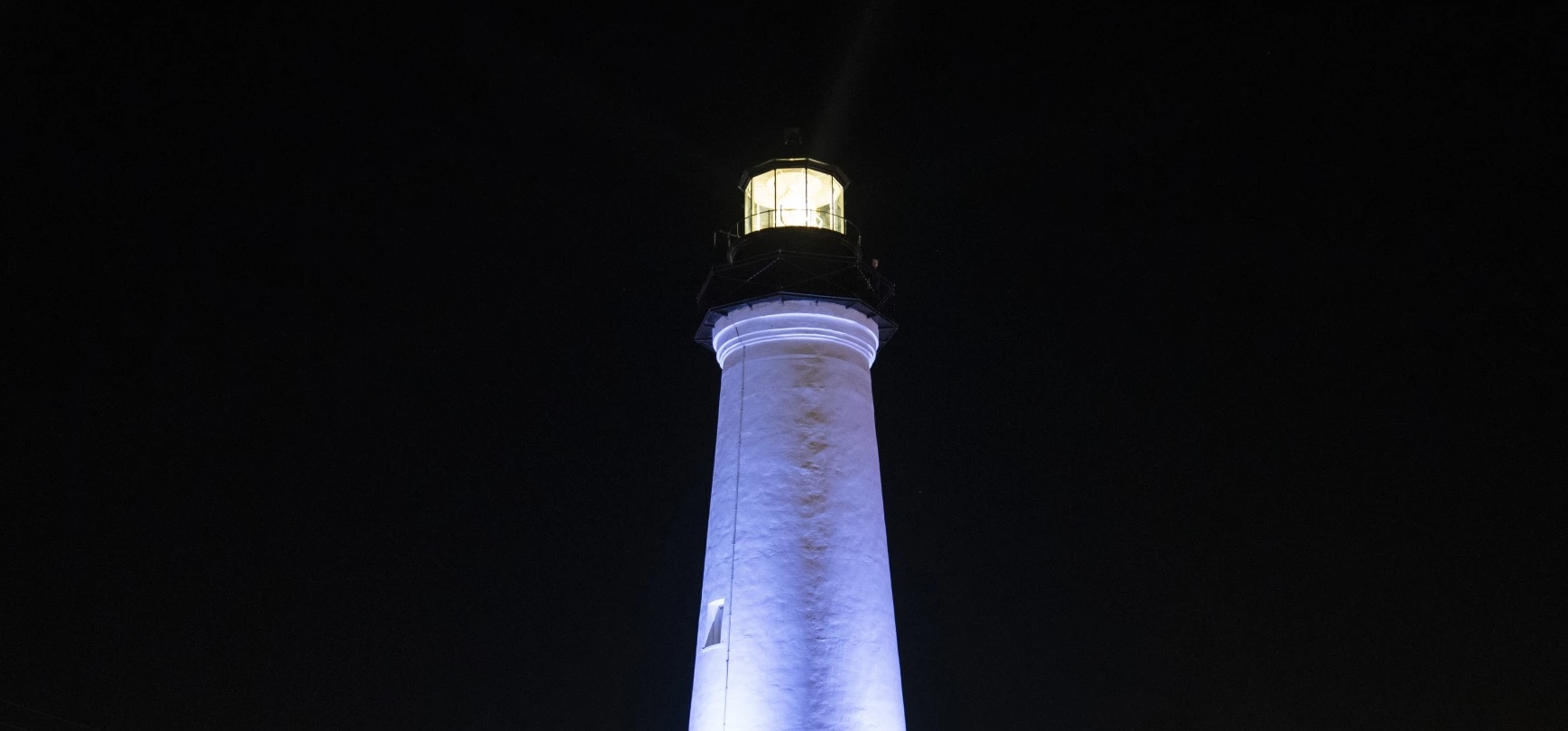
p/c V. Cardenas at TPR.
Spoiler alert: I’m going to ruin the end of a book by Michael O’Brien called The Lighthouse. The spoiler only applies to this paragraph, not the rest of my article. The main character in the book is a loner named Ethan who runs a lighthouse in Canada. By the end of the book, it seems his life is a failure. However, he ends up giving his life in a storm for a Nigerian man who later becomes a priest. Also, a wooden-sculpture of a bird he made in Canada washes up on a beach in Brazil to the delight of a little girl who finds it.
Although O’Brien doesn’t use the term, one of the themes of the book is “The Butterfly Effect,” namely, that even those small decisions of “unimportant people” will affect the lives of many other people across the globe, even in ways they could have never expected. This is Ethan. He runs a lighthouse on the East Coast of Canada by himself. He is nearly forgotten by even the nearest small town. Ethan never marries; he never has a family; he never becomes a priest. But somehow, his quiet life will affect thousands of people in the future.
The book also got me thinking about my life in the Church crisis. There is darkness and storms everywhere. I have spent a lot of time yelling into the storms, screaming into the darkness. It’s not all in vain—I truly want to warn people to stay away from heresy and abuse. But many sailors have gone down to their watery graves, cursing the storm with absolutely no power over it. So it could be in my life if I let the bitterness of the troubles in the Church engulf me.
I find I’m the worst version of myself in that mosh-pit called Twitter. There, I’m like a quiet lighthouse employee trying to get noticed by fighting sailors. Perhaps, I even feel the juvenile need to flex in order to sound even more angry than the rest of them amidst the storms of theological debate. It just doesn’t fit with who I am called to be.
But running a lighthouse like Ethan is different than braving the storms. There’s less cussing, less drama, less excitement than long-lining it. Also, the lighthouse job entails more loneliness than that of a married fisherman. The fisherman is out with his buddies on the dangerous seas. The lighthouse employee often has a quiet and awkward life. But it also affords more opportunity for contemplation.
The forgotten man who runs the lighthouse does not claim to be a Captain. The boat of the Catholic Church must be run by prelates, not by a man alone in a lighthouse. So, what is the point of a lighthouse? It provides a shining-light that is both unmistakable and self-evident. Perhaps it doesn’t matter on a clear day, but in the middle of a storm, it can save lives.
Notice I didn’t call this article To Be a Lighthouse Employee but rather Hoping To Be a Lighthouse Employee. That’s because my goal (not my success) in this Church crisis is to teach the ancient faith and ancient liturgy without screaming into the void anymore. So, if my articles are too negative for you, I might suggest you learn Scripture from me at VLX or my traditional catechism series at RCT. Those are the real fires to my lighthouse, not my silly takes on Twitter.
Pray that I can be that lighthouse employee and be content with my job without jumping too much into the storms online, or anywhere else that is unbecoming of someone who is called to light up the sky more than simply comment on the darkness.
Although written by a Methodist (not a Catholic) a hundred years ago, it still holds true for us traditional Catholics seeking relief: “But denunciatory rhetoric is so much easier and cheaper than good works, and proves a popular temptation. Yet is it far better to light the candle than to curse the darkness.”—William Lonsdale Watkinson in The Supreme Conquest, 1907.
Finally, you might like my Pentecost Sermon explaining how Mary may be our only guide in this current eclipse of the Church. I even go so far in that sermon to explain that in this unprecedented Church crisis, the Immaculata even may be a guide to Apostolic Catholics in a manner unprecedented even to previous ages of saints because of the darkness that currently surrounds us.