
p/c NASA.
Today we consider the intellectual pitfalls to the FSSP, SSPX and sedevacantists, specifically on the topics of the papacy and Vatican II to show no one has the “Rosetta Stone” to the Church crisis.
This is a very long one, but I think you’ll find it worth it if you can find the time to sit down and read it. It’s ultimately to unify—not divide—all the traditional groups under Jesus and Mary. But we have to start with humility towards each other. Humility is why you will see that I try to disprove even my own camp of views towards the Church crisis below.
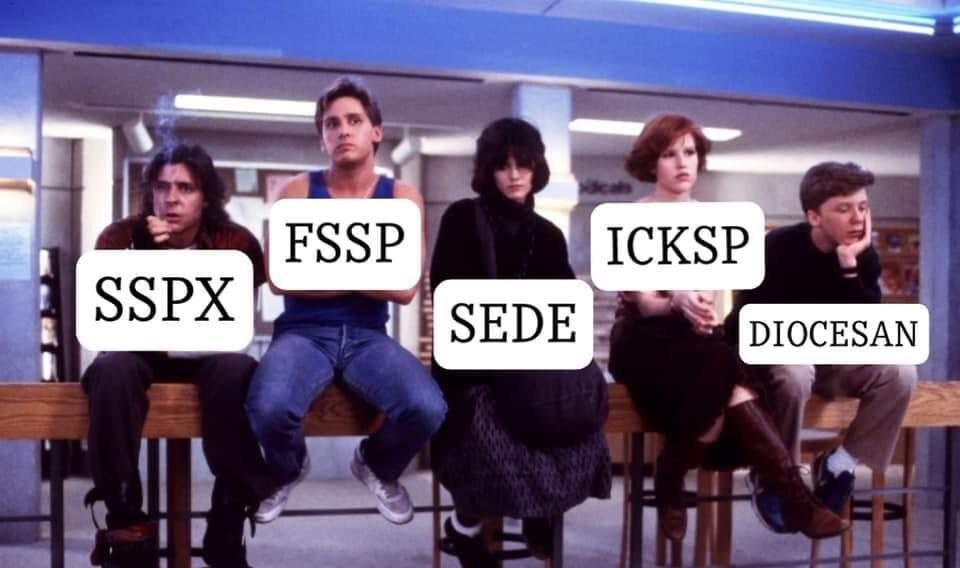
But let’s start at the basics for the few readers who are new to these debates: Many newcomers to the debates on the Fraternal Sacerdotal Society of St. Pius X (FSSPX or SSPX) are surprised to find that some traditional Catholic families would still attend SSPX Masses even as the Traditional Latin Mass (TLM) be available across the city by similar congregations that are canonically regular. For example, canonically regular options include the Fraternity of St. Peter (FSSP) and the Institute of Christ the King Sovereign Priest (ICKSP) and even diocesan TLMs that used to be called “indult Masses.”
Then, there are also the sedevacantists who do not believe there has been a valid Pope since 1958. We will look at their views in this article.
The fact is that the internal debates found in different traditional circles revolve around dogma much more than the Mass. This is because the SSPX, FSSP and sedevacantists all offer the TLM and the other six old sacraments. So, the divide must be on a different topic. The hot-button topic for nearly every traditionalist is Vatican II and the papacy. This is really where the incendiary debates are found.
Vatican II and the papacy are the battle lines where both the intense and thoughtful debates between traditionalists are happening. That’s because the value of the old sacraments over the new sacraments are already a “given” to most traditionalists of various stripes.
I am calling this article Doctrinal Pitfalls To Each Traditional Group to show why no one group is perfect. Not even my own view. Below, I am going to strong-man each group’s arguments. Then, I will explain intellectual pitfalls of their view as outlined by their opponents. I am doing this to show that if even I can show logical fallacies to each trad-view, maybe we should be charitable to each other.
It’s really that simple.
But before you get ramped-up to send me an email or leave a comment on Substack on why you really have found the Rosetta Stone to see the Church crisis (here’s looking at you, sedes) let me explain the goal of this article: It’s simply to show that if even I believe every trad stance has a blindspot, maybe we should give each other the benefit of the doubt and work for what we agree on. Oh, and the one who once proposed to “unite the clans” unnecessarily attacked me. So, this post is certainly not proposing we follow an old hypocrite like him.
I am also not writing this article to take sides or lose friends. Rather, the final point of my article will be that all traditional Catholics of goodwill should double-down on the one thing we can be sure of: That dogma never changes and the sacraments (including liturgy) only change at infinitesimally small rates through the centuries. And those changes only happen through addition, never subtraction, for the latter would constitute the silly jump from the TLM to the NOM.
You see, I am at a new point in my life where I believe heaven itself does not want us to have a perfect answer to the crisis if the Church is in eclipse at such unprecedented rates, especially as explained in Our Lady of Good Success. Only the Triumph of the Immaculate Heart will be the sun’s rays to dissipate the cloud of the eclipse. This is the best way I can understand Our Lady of Fatima and Our Lady of Good Success together.
That’s also why you will see below that I even poke holes in my own views of the Church crisis.
I point to the holes (not the advantages) in each of the trad movements so everyone can understand that if both their convictions and their opponents’ convictions limp along, then we must strive for only what the Church has always taught while being still charitable to each other. Also, before starting, please realize I could write five pages on each of the following groups. This means you should consider this a beginners’ guide to the Church crisis. And no AI has ever been used in any of my articles, including this one.
GROUP A: TRADITIONALISTS WHO PROMOTE A “RECOGNIZE AND RESIST” APPROACH TO THE CONCILIAR PAPACY.
-SSPX… Definition: French Archbishop Marcel Lefebvre (29 November 1905 – 25 March 1991) is rightly seen as the father of the traditional movement. This is because the SSPX sprung directly from him, while the FSSP fractured to his left and the sedevacantists fractured to his right. But initially, they all came from him. Although Lefebvre initially signed the documents of Vatican II, he later opposed Vatican II vehemently. Archbishop Lefebvre founded a seminary for the SSPX in 1970, but he did not make international news until a full 18 years later. That was when, in 1988, he consecrated four bishops without papal mandate in order to keep tradition alive. From the Holy See, there were then statements of automatic excommunication against such clerics in both 1988 and again this month of July 2026 for repeating the same actions.
Advantage: The advantage of the SSPX is that they have maintained the ancient liturgy and ancient faith with minimal involvement in papal politics. This might read as inaccurate considering the recent “excommunication news.” But most traditional Catholics who I know who have travelled as much as me repeatedly find that SSPX communities maintain the highest levels of charity and psychological health in both their priests and lay folks, especially when compared to other traditional groups. With half a million faithful, the SSPX has truly kept the ancient faith and nearly-unchanged liturgy alive unlike any other group on the planet.
Pitfall: The FSSP and sedevacantists (who rarely agree on much) both insist that if the SSPX names “Leo” as Pope in the Roman Canon (which they do) then the SSPX should obey him when he tells them not to consecrate bishops without his mandate. The FSSP insists that the SSPX is sinning in such disobedience precisely because both congregations believe that Leo is a validly elected Pope. On the other hand, the sedevacantists say Leo is not a valid Pope, yet maintain that any priest of the SSPX who names Leo name in the Roman Canon of the Mass should obey him on any matter of faith, morals or discipline. Of course, the SSPX has some pretty advanced loopholes as to why they believe they are immune from this. But most traditionalists outside their community are not convinced by it.
-FSSP, ICKSP and Former Ecclesia-Dei groups… Definition: In 1988, when Archbishop Lefebvre consecrated bishops without a papal mandate, some of his own traditional priests (eg Fr. Bisig) left him. They went to Pope John Paul II in order to pledge obedience to the Holy See while still requesting access to the TLM. The Pope granted this following a document called Ecclesia Dei Adflicta. But Ecclesia Dei also became a Pontifical Commission (now defunct) for Latin Mass congregations maintaining a status of being canonically regular with Rome. Such groups included the FSSP and ICKSP. They have had close collaboration with Cardinal Hoyos and Cardinal Burke. Although not under the umbrella “Ecclesia Dei” anymore, they stem from this Pontifical Commission.
Advantage: Provided one rejects the sedevacantist position, the former-ED congregations’ approach to the papacy and the TLM is the most externally-coherent approach among all traditionalists. That is, the FSSP and ICKSP maintain obedience to the very leader of the faith whom they name in the Canon, while also maintaining the traditional seven sacraments. It is the best of both worlds while maintaining the title “Catholic” and “loyal to the Pope,” which really are one in the same. This definitely seems the most Catholic position when it comes to maintaining the ancient liturgy and modern obedience in tension as a traditionalist after the Council.
Pitfall: The FSSP’s public stance is that they accept every part of Vatican II, including “religious liberty, ecumenism and collegiality.” However, many of their priests privately reject these errors. They seem to believe this is a clever strategy to keep the Latin Mass in normal diocesan bounds. But morally, this is nothing short of a giant public lie. Such priests need to consider that Scripture places both cowards and liars in the exact same place as murderers and sorcerers: But as for the cowardly, the faithless, the detestable, as for murderers, the sexually immoral, sorcerers, idolaters, and all liars, their portion will be in the lake that burns with fire and sulfur, which is the second death.—Apocalypse 21:8
GROUP B: TRADITIONALISTS WHO REJECT A “RECOGNIZE AND RESIST” APPROACH TO THE CONCILIAR PAPACY, AS A TRUE POPE DESERVES OBEDIENCE.
-Sedevacantist, totalist… definition: “Totalists” among the sedevacantists are the traditional groups who assert that because the papacy is the only protected office in the Catholic Church against heresy, and because there has been at-least material heresy from every Pope from John XXII onwards (or some would name Paul VI) then all Popes from the 50s or 60s onwards lack validity. Hence, we have the term “58-sedevacantism” loosely translated from the Latin as “Chair [of Peter] has been empty since 1958.” Some hold to the “Siri thesis” that Cardinal Siri was named Pope instead of Roncalli in 1958.
Advantage: This is internally the most cohesive system if one adheres exclusively to the pre-Vatican II faith and sacraments. St. Robert Bellarmine said, “A Pope who is a manifest heretic automatically (per se) ceases to be pope and head, just as he ceases automatically to be a Christian and a member of the Church.”—De Romano Pontifice II.30. And because sedevacantists have mountains of evidence that every claimant to the Chair of Peter since 1958 has taught some form of material heresy, they can easily assert that none of these claimants are valid Popes. This makes it easy for them to “disobey” them without qualms of conscience. Why? Because one owes absolutely no allegiance to a false pope.
Pitfall: Vatican I’s Pastor Aeternus holds infallibly that the Roman Catholic Church must have “perpetual successors in the Primacy” to St. Peter as Supreme Pontiff. And yet, 58-sedes say we have not had a valid Pope since 1958. Thus, they apparently reject Vatican I. Of course, they all have numerous legalistic-loopholes to work around this accusation. But all sede arguments practically fail at explaining a whopping 70 years of an ostensible-absence of the promise of Christ Himself to St. Peter in Mt 16 on the papacy being the unshakable rock of the Church. (I once had a sede priest tell me if we had no Pope for 300 years, it would still not challenge his position!)
-Sedeprivationalists… definition: Following “the Cassiciacum Thesis” of Bishop Guérard des Lauriers, these sedeprivationalists believe the claimants to the Chair of Peter since 1958 have been material Popes, but not formal Popes. This is because they have jurisdiction, but not authority, due to the alleged-popes’ (during and following Vatican II) own adherence to heresy. This is their own personal “work-around” in order to maintain adherence to Vatican I.
Advantage: This solves the problem of Vatican I, for that Dogmatic Council (and Christ in Matthew 16) promises “perpetual successors.” This is something the totalist-view of the sedevacantists cannot account for. Thus, for the sedeprivationalist, there have indeed been true material Popes since 1958, but no formal Popes until one of them renounces his heresies. They maintain the best of both worlds: Vatican I is not rejected and yet heretical “Popes” need not be obeyed. Thus, sedeprivationalists cannot be accused of rejecting the notion of “perpetual successors” to St. Peter. All the while, they need not obey the post-Conciliar Popes who they claim are “material, but not formal Popes.” This is because they have a human-based jurisdiction but no Divine Authority.
Pitfall: To divide the papacy between “material” and “formal” as well as the gifts of the papacy between “jurisdiction” and “authority” has no precedent in Church history over the past 2,000 years. In fact, it smacks of Protestant dualism in dividing something simple (like the papacy) into complex terms like “material” and “formal” or “jurisdiction” and “authority.” Can you imagine Christ at Lake Tiberias expected Peter the simple Fisherman to believe some of his successors would one day be quasi-Popes maintaining a material papacy but not the formal papacy? It’s so irrational as to be desperate. A good refutation of the Cassiciacum thesis is found here by a totalist sedevacantist.
-Interregnumists, definition: These are also called Bennyplenists or 23-sedevacantists insofar as they do not believe we have had a valid Pope since 1 January 2023. This is because the last reigning Pope (perhaps the last Pope ever!) was Pope Benedict XVI who died on 31 December 2022. Hence, the term “23-sede.” Yes, Benedict reigned, despite thinking he could bifurcate the papacy into a “contemplative Pope” and an “active Pope.” Interregnumists often point to the dark prophesy of Our Lady of La Salette claiming towards the end of time there would be “two worm-ridden doubtful Popes” before the arrival of the Great Harvest bringing millions into the Catholic Church at Fatima’s age of peace when a valid Pope accurately consecrates Russia to the Immaculate Heart of Mary. Or perhaps, Fatima’s “in the end, my Heart will Triumph…” is truly the final end.
Advantage: Instead of looking at the teachings of post-Conciliar Popes, most interregnumists start with the fact that around 2012, both Pope Benedict and Cardinal Bergoglio’s own friends publicly admitted to scaring Pope Benedict off the Chair of Peter. Even the new code of Canon Law teaches attempting to resign under duress is invalid. I have written on these topics here and here and here. Obviously, interregnumists maintain perpetual successors to St. Peter much better than who my friend Pat lovingly calls “the sedevax.” This is because the papacy has already been interregnum (without a Pope) for nearly three years in the Middle Ages, namely, from November 1268 to September 1271. And because interregnumists believe the Chair has only been empty of a valid occupant for a few years, they avoid the intellectual pretzel-twisting around Vatican I’s promise of “perpetual successors” done by 58-sedes. Of course, the sedevax will say this divide between three years and 70 years of no pope is purely arbitrary. But God uses common sense more than logical games, so that accusation of “arbitrary” is clearly a failure. Indeed, for the sedevax, the Chair of Peter is now practically a dusty and obsolete entity, even if this is denied by them at a theoretical level.
Pitfall: Every time an interregnumist explains his position to the sedevax, the latter will bring up something like John Paul II at Assisi in 1986. Even One Peter Five (a production that normally avoids both the views of the interregnumists and the sedevax) has an article here explaining that Assisi ’86 can hardly be considered anything less than apostasy. That’s because all world religions were promoted in a manner clearly adhering to the heresy of religious indifferentism at that gathering of religious leaders from across the globe. Thus, the sedevax rightly challenge the interregnumists: “What is the point in defending JPII in making acts of public apostasy if one just mildly attacks Francis and Leo? That is, all post-conciliar popes seem cut from the same cloth of heresy, so why split hairs on canon law resignations that happened in 2013?” Thus, the sedevax have just as many destructive arguments against the interregnumists as vice-versa. God, please come and rescue us from this madness…
Hermeneutic of Continuity “Conservative Catholics”… Definition: This is the one who likes the Latin Mass, but he finds no errors in Vatican II or the recent Popes. He has no need to “recognize and resist” the papacy because he approves of Assisi 1986. Thus, he is put under the non-resist category because he is good with either new Mass or old Mass, pre-Conciliar or post-Conciliar teaching. Indeed, the “hermeneutic of continuity” teaches that if you simply squint intensely enough, you can reconcile Catholic teaching before and after 1965; you can also meld Catholic liturgy before and after 1965 if you just try hard enough intellectually. This was the project of Pope Benedict XVI that I completely tried in seminary and even after ordination at several of my novus parishes.
Advantage: The Hermeneutic of Continuity Catholic can maintain the best of both worlds, namely, obedience to conciliar popes and even Vatican II while simply maintaining an ascetical preference for the pre-Vatican II sacraments. Maintaining “that Vatican II did not create a new religion” certainly helps defend the classic dogma that “the Catholic Church is indefectible.”
Pitfall: In 2021, Francis said the following about Vatican II: “This is the Magisterium. The Council is the Magisterium of the Church. Either you are with the Church and therefore you follow the Council, and if you don’t follow the Council or you interpret it in your own way, as you desire, you do not stand with the Church.”
Notice he is clearly saying that conservatives who interpret “The Council” differently from him are now going against his “Magisterium.” Implied in this is that Vatican II (including religious indifferentism) is the exclusive Magisterium of the Catholic Church. Obviously, such a take is absolutely incompatible with 19 centuries of Catholic teaching prior. And he knows this, meaning he meant to give a final death-blow to Pope Benedict’s most precious project of a “hermeneutic of continuity.”
And a New Magisterium is obviously a New Religion—the one area where lukewarm conservative Catholics fear to tread—but liberal Catholics do not!
Ah, but a new religion is impossible if such an entity is still to be considered the Catholic Church, for God says through the prophet Malachi: For I am the Lord, and I change not.—Malachi 3:6. (Dominus non mutor, in the Vulgate.)
In other words, the one ecclesiastical view that is absolutely impossible by this stage of the Church crisis is “the hermeneutic of continuity.” Yes, this is true, even according to the current Vatican. That is why it is so dishonest that a whole group of former-traditionalists (or so they seemed) are now defending the hermeneutic of continuity. Why have they switched beliefs? This is presumably for advance in finances or popularity. Yet, it’s nothing short of a Judas-betrayal of the Catholic Church in her own crucifixion.
Everyone who has read the Third Secret of Fatima says Our Lady was referring to “apostasy from the top-down.” Certainly, this must be the only explanation by this point in the free-fall of the Catholic hierarchy, even if we can’t fully explain why God has allowed some things in Rome. And those lay trads doing damage control for them will probably join them for all eternity. That’s not a tough-guy threat from me. It’s just logic on obedience.
Of course, every Catholic today wants to be obedient. But the choice put before us now is unfortunately as follows: Because there’s a “New Magisterium,” every Catholic must choose between being obedient to 19 centuries of Catholicism or this one century of “Catholicism.” If there’s a Pascal wager on my soul at stake, I’m going to go with the preponderance of evidence. That is why I’m a traditional Catholic.
This leads us to consider the brilliant teachings of St. Vincent Lerins who taught very simply what we must do until we have a heavenly rescue from this madness of modernism. The saint and doctor of the Church writes this:
What then will a Catholic Christian do, if a small portion of the Church have cut itself off from the communion of the universal faith? What, surely, but prefer the soundness of the whole body to the unsoundness of a pestilent and corrupt member? What, if some novel contagion seek to infect not merely an insignificant portion of the Church, but the whole? Then it will be his care to cleave to antiquity, which in the present cannot possibly be seduced by any fraud of novelty.
You see, when a novel contagion has infected the nearly whole of baptized believers, the final true Catholics will be united in only one thing: Clinging to Christ and a decision to “cleave to antiquity.” Yes, this really is traditional Catholicism in the midst of the modernist onslaught. But I now believe (contrary to some of my earlier writings) that the decision to heroically “cleave to antiquity” will determine your salvation more than finding the perfect Rosetta Stone to seeing through the current mystery of iniquity in Rome.
That is why I accept every group above as real traditional Catholics today in the 21st century, except the hermeneutic of continuity folks who are sell-outs. No need to kick anyone out of Christ’s army, anymore in this final battle. We need to remember the words of Our Lord on what will happen at the end of the world:
And many false prophets will arise and lead many astray. And because lawlessness will be increased, the love of many will grow cold. But the one who endures to the end will be saved… For false christs and false prophets will arise and perform great signs and wonders, so as to lead astray, if possible, even the elect.—Saint Matthew 24:11-13, 24.
Notice that under false-prophets, the love of many will grow cold, presumably even among solid Catholics. Thus, we Apostolic Catholics must absolutely maintain charity towards one another. And finally we must ask: What else could make Our Lord imply something so horrible as the final group of the elect nearly missing their salvation than if the final false-prophet ostensibly led them?
Key adverb there is ostensibly.
So, we “cling to antiquity” in order to be saved. Drop charity, and you cannot be saved. Let’s persevere on this until the Triumph of the Immaculate Heart of Mary, together as traditionalists on the many things we can know for sure.
Thank you if you can donate.