The only novel I have read since ordination was Michael O’Brien’s Island of the World. It’s a gripping and grinding historical-fiction account about a man named Josip who grows up in Croatia in the 1940s. His family and community is then destroyed by Tito’s communism. Josip is sent to a gulag called Goli Otok in real life. There, he is tortured and loses his faith. After escaping, he wanders Italy and finally ends up a janitor in NYC. Does he regain his faith? You’ll have to read the book. It was so good I read it twice since ordination.
Since reading Island of the World, I have had a healthy fascination with Croatia. The book captures the fact that Croatia is the crossroads between a Catholicism that can be described as both Western and Eastern (although it is certainly more Roman Catholic than Byzantine Catholic.) Croatia is known as one of the most beautiful countries in Eastern Europe. Like many countries in Eastern Europe, it had a large percentage of its population killed by Marxists.
How does Catholicism survive in a place like this? Precisely because of her saints and martyrs. The fictional Josip was based on several real men.
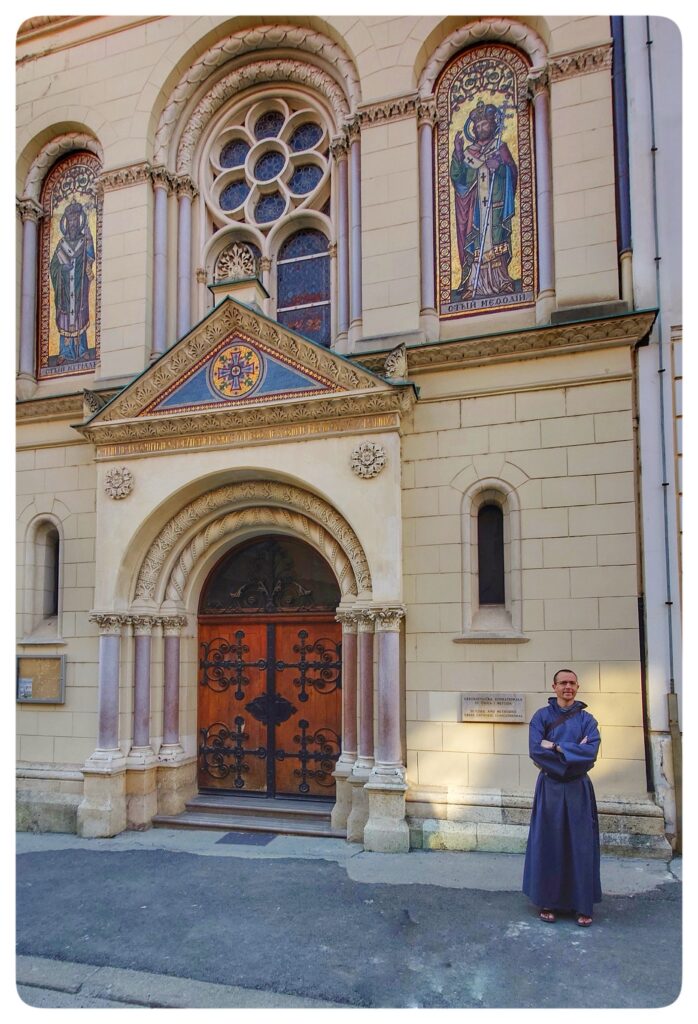
Recently, I was asked to speak at a conference in Zagreb, Croatia on the topic of Christ the King. Apparently, I was needed as the pinch-hitter in place of an American Archbishop who canceled at the last minute.
Although I don’t usually agree to unplanned travel situations, my love of Croatia and this group’s need for a keynote speaker urged me on to say “yes” to this last minute invite. The people and the land of Croatia did not disappoint. I found them (equal to perhaps only the Brazilians?) to be the most hospitable people in all my travels.
You can also hear my talk on Christ the King given there that contains a quick jaunt through the Croatian Catholics fighting the Muslims for 500 years and the Communists for 50 years. It was at a conference held by the Apologetic Association of Blessed Ivan Merz.
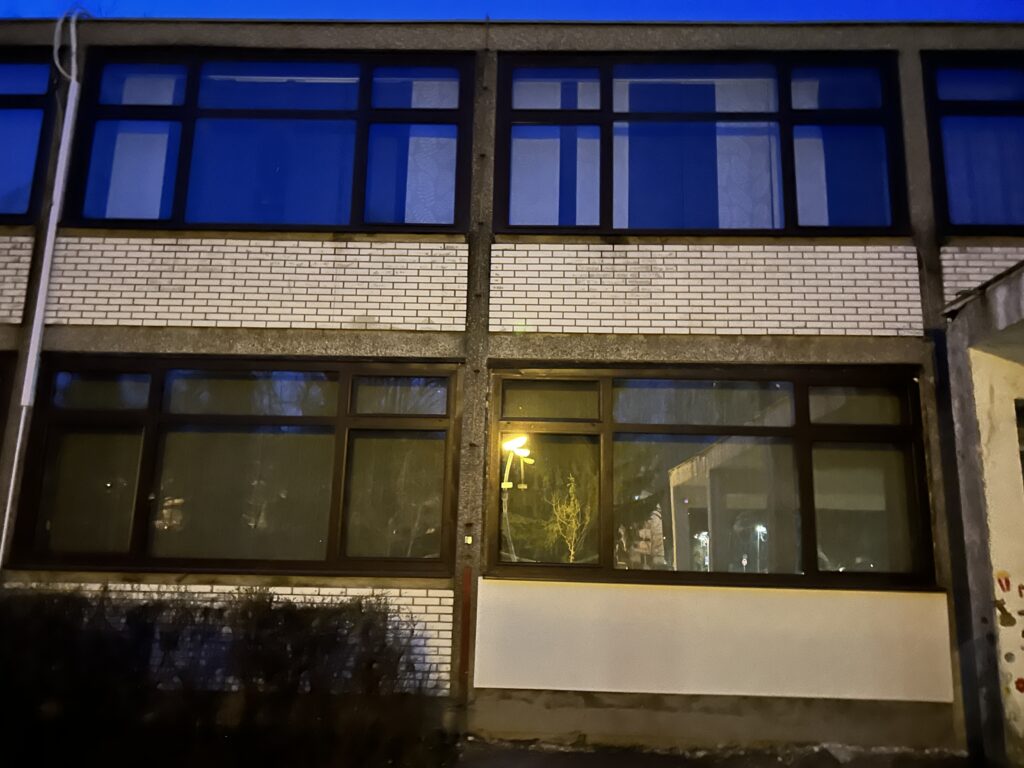
Marko’s school
As always, I learned more than I taught. My last night there I stayed with a single man about my age who grew up in the same neighborhood as that in which he currently lives. We will call him Marko in this article. Above, is the grade-school where he went in the 1980s.
He recounted to me what it was like to grow up under Tito’s regime the same time I was in grade-school in Colorado. The teacher would call one of the students to stand in front of the blackboard who would then yell: “At attention! For homeland with Tito!” Then, all the other students then had to reply: “Forward!” (while putting their fist to their temple.) Obviously, this was indoctrination for the children. It exacted undying loyalty to the system.
The communists had to ferret out any Christian children because they were more difficult to control. Marko explained to me that his communist teacher would regularly make other students rat-out any Catholic students who still attended religious education. Marko did attend catechesis, so he prayed hard he wouldn’t get caught. He hadn’t really had his reversion yet to see that suffering for Christ was glory on earth.
Many years later, Marko had a big conversion, or at least a reversion where he truly decided to follow Christ crucified in a fearless manner. He now attends the Traditional Latin Mass.
At one point a few years ago, Marko was shamed away from one of his Novus communities for publicly challenging Amoris Laetitia, the document that allows “divorced and remarried” couples to sacrilege the Eucharist by approaching Holy Communion with no declaration of nullity.
Having lived under both communism and modernism, Marko amazingly told me that Catholics living under the modernists is now more difficult than living under the communists.
He explained it this way: At least when he was a child and he was persecuted for the faith under the Tito regime, the enemies of the faith were hostile to believers in the open. But now, under modernism, Marko told me that it’s more difficult to be Catholic than even in the 1980s. When I asked him why this was the case, he quickly replied: “Now, we don’t know who the enemy is!”
Basically, the current modernist hierarchy dresses up as Catholics, but they have the same ecumenical view towards world religions as the communists under Tito.
One thing Marko added on WhatsApp to me before I published this article was: “The communists persecuted the Church from the outside, today’s neo-modernists persecute faithful Catholics from the inside, which is much, much worse. After World War II, the communists in the area of today’s Croatia did not destroy Churches, but in some rare cases allowed the construction of new Churches. It is interesting that the communists preserved the old altars in the Churches by not giving the neo-modernists permission to remove them after 1969. The communists saw artistic value in the old altars.”
So we see the same plight of trads against modernists the world over since the 1960s. God, please rescue your Church soon.