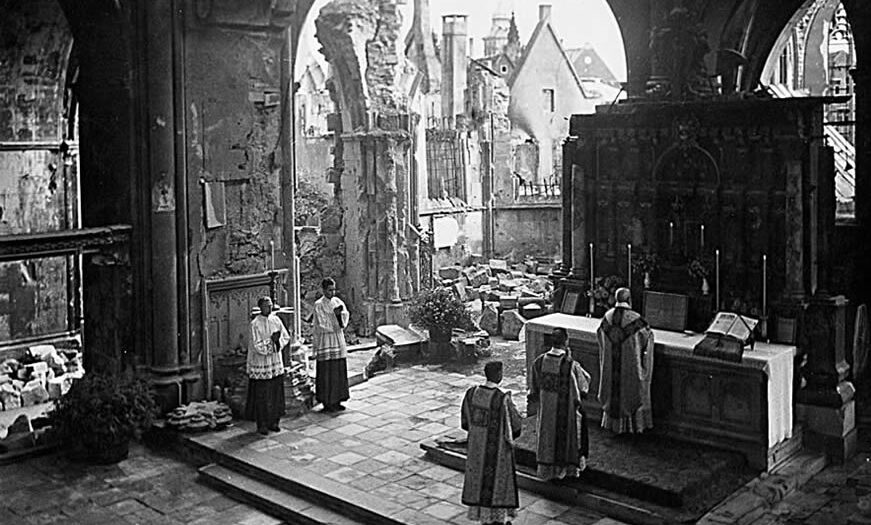
In my last article, Fatima, Darwin and Dogma, we looked at how Darwinian evolution erroneously led most Catholics of the 20th century to believe dogma could evolve like a species. We saw how this was no small part of Mary’s dreaded “errors of Russia.” So also, if dogma can change overnight, then the liturgy can morph overnight, too. (Of course, we know that the Bible and the Magisterium make it clear that neither a species nor Divine Revelation can evolve. But one false premise, namely, Darwinian Evolution, can strangely affect even the Holy Mass.)
Let’s ask an important question: Is tradition a living thing? This is a tricky question. If the traditional Catholic answers “Yes,” then he admits to the modernist that tradition can develop or grow quite rapidly, which is detrimental to our cause, namely, that God’s mind does not change with the fashions of the time on dogma or liturgy. However, if the traditional Catholic answers “No,” then he steps into the modernists’ trap, making us sound like we believe Divine Revelation is nothing but a computer program of ones and zeros, a binary system with no love and no relationships, a syllogism which implodes after one simple mistake.
The only answer is this: The seven sacraments given by Christ to the Apostles have only been modified over the last 19 centuries with nearly imperceptible changes, at least up until Vatican II (which clearly overhauled them all.)
So, why is it so important that we use precise words like “nearly imperceptible changes”? Because modernists are tricky and want to catch us on small mistakes. We have to be very careful when speaking to heretics.
For example, the Council of Trent says Christ gave the Roman Canon to the Apostles, albeit not in Latin and minus some saints (added later.) The Council of Trent says of the Roman Canon: “For it is composed, out of the very words of the Lord, the traditions of the apostles, and the pious institutions also of holy pontiffs.”
Thus, it’s Apostolic in origin.
Yes, there were tiny non-substantial changes to this ancient Mass through the centuries. One example of this is the prayer at the foot of the altar (Psalm 42) added to the Traditional Latin Mass (TLM.) These prayers were added gradually until they were crystallized in the 9th century. Then, they were codified by Pope St. Pius V in the 16th century. So, yes, there were tiny little additions every century.
But that does not justify the total gutting of the Roman Rite that happened in the 1960s. What happened then would not be described even by liberals as “nearly imperceptible changes” to the seven Roman sacraments. Everyone knows it was a total gutting and overtake.
Many today justify the overhaul with the philosophy of antiquarianism (eg “the new Mass is actually older than the old Mass!”) However, anyone who has studied modern Church history knows this is a lie, as even the official annals of Vatican II admit that Protestants helped write the new Mass of Pope Paul VI.)
I recently posted on Twitter: “By now, I am sure everyone has seen Cardinal Roche’s letter against the TLM spread through the recent Vatican consistory. You all know who approved of that back-channeled document in the Vatican… But remember last year, I publicly warned the conservative Cardinals that when you make a deal with the devil, you lose not only the thing you thought you were going to lose in your Faustian bargain (defending the faith) but you also lose that one thing the devil made you think you were going to get to keep (the TLM.) People got mad at me for saying this, just like the normies were mad at me four years ago telling them not to take the mRNA shot. Well, I am right again.”
Roche holds to an evolution of the sacraments as seen in his recent 2026 letter to the Vatican consistory Cardinals: “In this dynamic vision, maintaining solid tradition and opening the way to legitimate progress cannot be understood as two separate actions: without a legitimate progress the tradition would be reduced to a collection of dead things not always all healthy; without the sound tradition, progress risks becoming a pathological search for novelty that cannot generate life, like a river whose path is blocked separating it from it’s sources.”
Notice that Cardinal Roche refuses to elucidate just how rapidly his imaginary “river” of liturgical change should flow. Too slow, and he would have to admit that before Vatican II, the seven sacraments given by Christ to the Apostles have only been modified over the last 19 centuries with nearly imperceptible changes. Too fast, and he would have to admit real Catholics might call him out for what he said would be a “pathological search for novelty.”
Thus, he proposes a lukewarm middle ground of his imaginary liturgical river flowing and changing at an arbitrary pace that allows anything except the Apostolic Mass.
Yet Cardinal Roche knows the recent Church history in his home country of England. He knows that in the UK, the Novus Ordo is almost dead. There is no “evolution”capable of keeping the new Mass thriving beyond life-support. There is no flowing river of life in the novus world. It doesn’t matter how many bells and whistles you put on it—very few Englishmen want it. Yet, more and more Englishmen want the TLM. I have met such intense Catholics on my trips to the UK. Some live in poverty, others in riches.
They know they could go to the Episcopalians or Anglicans for liturgy just as “high” if they wanted. But not all pretty things are valid. I think they all know: Every twist and turn of Roche’s silly evolutionary river is a dead end, one that has led to empty Churches and dusty sacristies. Thus, Roche must attack the one Mass that does not partake in evolution and still gives life: The Traditional Latin Mass.
Mr. Stephen Kokx recently reminded his listeners that Roche could only promote such liturgical destruction in the Vatican consistory with permission of his boss. (This means the traditional Catholic outlets attacking the little heretic while defending the big heretic are either cowardly or dishonest—two qualities of the damned in the book of the Apocalypse.)
Now let’s pivot to some good news.
Thankfully, the families who reject evolution are reproducing biologically. Similarly, the traditional priests who reject evolution are reproducing spiritually. Cardinal Roche and friends can mock us, attack us, apparently even reduce the use of the TLM across the globe. But the Apostolic sacraments and the Apostolic dogma will never die. The bad guys forgot that real Christians grow under pressure. Just look at the history of Catholics in the UK, from St. Thomas More to Chesterton.
So, back to the connection between Fatima, Evolution and Liturgy: Evolution is a lie because mutation always follows the pathway of entropy of a species, not advance of a species. Just as in biology, mutation is always deleterious—never advantageous. So also in liturgy, mutation is always deleterious—never advantageous.
The original TLM and Apostolic dogma will never die, because it’s the original. Species, dogma and liturgy do not develop, except by infinitesimally small measures. Thus, we Apostolic Catholics will cling to it, even under persecution, even if Christ returns in glory to find only one traditional priest clinging to both the Apostolic dogma and the Apostolic liturgy in some cave of South Africa.
Yes, we must all continue to reject Darwinian evolution and instead follow Christ’s own plan on dogma. We also must reject the failed hermeneutic of continuity in order to follow Christ’s own plan on liturgy and sacraments. Rejecting evolution is ironically the only way to life.
All my education is free for all, so please consider donating here.