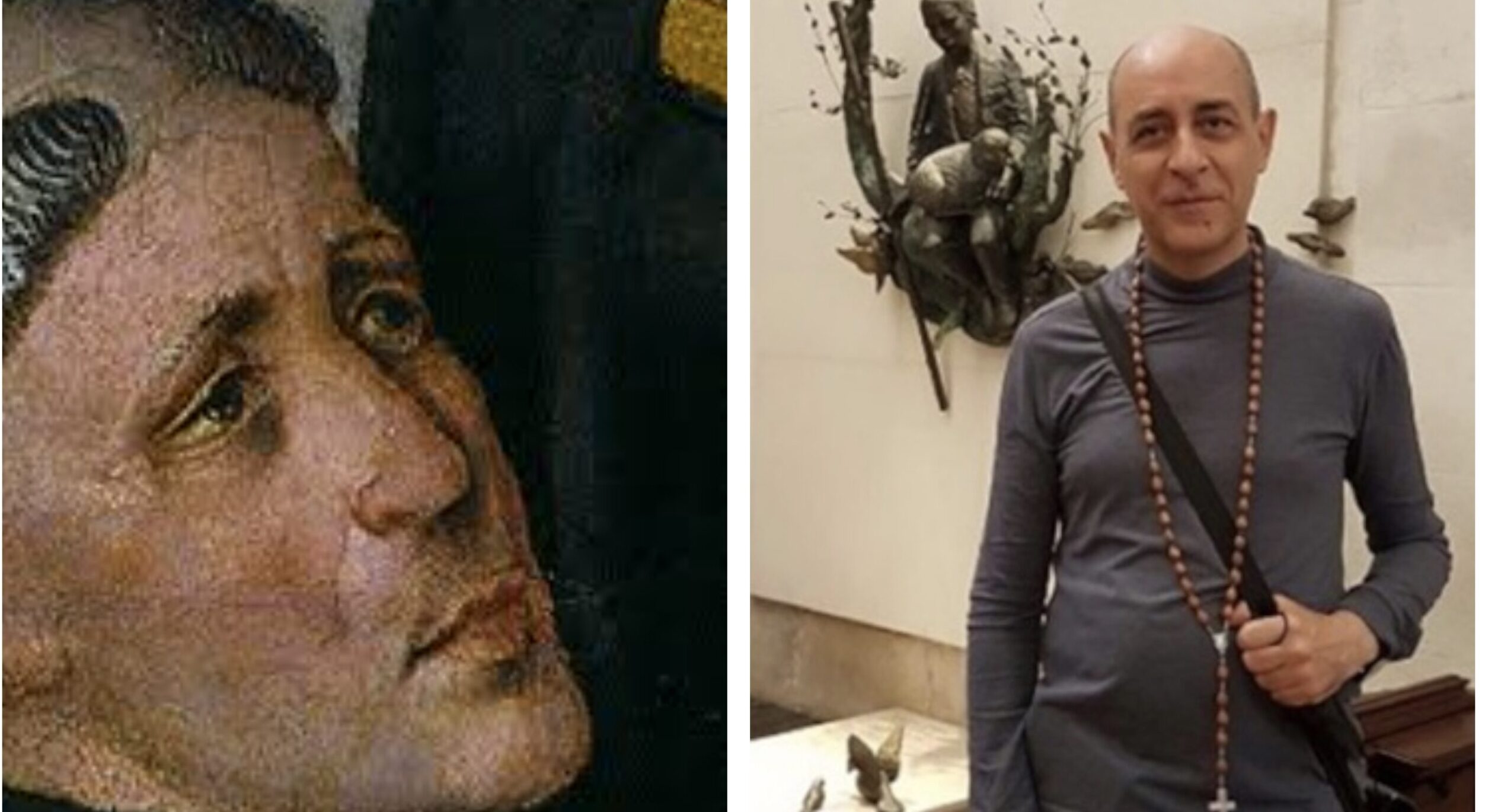
Today, we are going to look at canonical due-process as executed by the 15th century Spanish Grand Inquisitor, Tomás De Torquemada (top left) versus that of Cardinal Tucho Fernandez (top-right.) Tucho is the Cardinal who allegedly-excommunicated the SSPX recently on 2 July 2026. (SSPX is the American abbreviation for FSSPX which stands for the Fraternity of the Priestly Society of Pope St. Pius X.)
Although a heretic can’t excommunicate anyone (as explained here by the WM Review) we are going to suspend that obvious ecclesial reality in order to evaluate the difference in legal process between the 15th century Dominican and the porn-writer currently living in the Vatican.
Fr. William Saunders of the Diocese of Arlington wrote a short two-piece series on the Inquisition. In Part 1, he wrote the basics of why the Inquisition was established:
The Lord entrusted the Church to preserve the deposit of faith and to hand on the authentic faith to later generations. At the Ascension, Christ said to the apostles, “Teach them to carry out everything I have commanded you” (Mt 28:20). Therefore, heresy – “the obstinate post-baptismal denial of some truth which must be believed with divine and Catholic faith” (Catechism of the Catholic Church, No. 2089) – was considered a particularly grave sin. Not only was a heretic’s soul in jeopardy, but also his false teaching jeopardized the souls of others. The Church, as the guardian of souls, has the duty to identify and “root out” any such heresy and thereby to protect the innocent faithful. While a heretic cannot be forced to recant error, he must not corrupt the faith of the innocent faithful with his errors.
We will now compare his writings on the Spanish Inquisition to the recent legal-failures of Cardinal Tucho (aka “Kissy”) Fernandez against the SSPX. Cardinal Fernandez is now head of the DDF, formerly the CDF, formerly “the Inquisition.” Information below on Torquemada will come from Fr. Saunders’ Part 2 on the Inquisition found at the Arlington Herald (abbreviated below as AH.)
Torquemada’s Inquisition: “To ensure due process, the inquisitors followed a guide, Processus Inquisitionis (1249), which specified the procedure, outlined various acts and provided commentary about certain cases. If a person was accused of heresy, he would be ordered to appear before the Inquisition.”—AH.
Tucho’s Inquisition: The SSPX has never been charged with heresy. In fact, the SSPX has never even been summoned to defend themselves against the new charges of schism. On top of this, the new 1983 Code of Canon Law actually favors conscience above objective theology. Can. 1323 4° reads: “No one is liable to a penalty who, when violating a law or precept… acted under the compulsion of grave fear, even if only relative, or by reason of necessity or grave inconvenience, unless, however, the act is intrinsically evil or tends to be harmful to souls.” SSPX claimed exactly that— a “necessity” in consecrating bishops due to the salvation of souls needing traditional doctrine and sacraments. Whether you agree with them or not on that, it actually doesn’t matter. Why? Again, according to the new Code of Canon Law, subjective conscience is above objective law when dealing with canonical punishments. In fact, behind the Iron Curtain in the 1970s facing Communism, Cardinal Slipyj and Cardinal Wojtyła disobeyed the Vatican in ordaining priests and bishops against the express desires of Pope Paul VI as explained here.
Torquemada’s Inquisition: “The accused would take an oath swearing to tell the truth. He was confronted with the evidence.”—AH.
Tucho’s Inquisition: No evidence was necessary for Tucho. Tucho and his globalist superior now claim to have excommunicated not just the clergy of the SSPX, but even laity who “formally adhere” to the Society. The threshold to determine “formal adherence” included those who “habitually participate” in the sacraments of the SSPX. That’s somewhere between 100,000 and 500,000 Catholics across the world. But had this been a valid excommunication, each one of those clergy of the SSPX plus the laity who attend their chapels would have had the opportunity to hear their canonical charges of schism or heresy directly from the Vatican or their local ordinary (bishop.) Had Tucho in 2026 been as accurate (or even as merciful) as the Dominican Torquemada in the 15th century, SSPX clergy and laity would have been shown evidence of heresy before receiving arbitrary accusations of schism. If the Vatican today were as lenient as the old-school Inquisition, Catholics who attend SSPX chapels would have been given the opportunity to either swear allegiance to the Catholic Church or given the opportunity to recant. In fact, this oath would have been afforded them both before and after their canonical trial according to the Inquisition. So, each of these cases would have included individual canonical trials, not a sweeping condemnation of hundreds of thousands of baptized sons and daughters of the Church.
Torquemada’s Inquisition: “The accused had to supply witnesses in his defense: Inquisitor Eymeric stated, If the accused has public opinion against him, but nevertheless it cannot be proved that he has deserved his reputation as a heretic, he has only to produce witnesses who can testify to his condition and habitual residence, and who, from long knowledge can affirm that he is not heretical.”
Tucho’s Inquisition: First of all, rejecting Vatican II is not a heresy. This is because Vatican II was a pastoral council, not a dogmatic council. So that accusation is like saying they rejected a flamboyant get-together of bishops. But even if it were a canonical crime to reject Vatican II, each one of the lay faithful who attend the SSPX should have received the opportunity to acknowledge their charges, obtain a canon lawyer, evaluate the evidence and ultimately make an oath of faithfulness to the Catholic Church and her Magisterium. Of course, none of this happened because Tucho knew he broke numerous aspects of canonical procedural law in his kangaroo court against the SSPX. This can be proved not only by the 1917 code of canon law, but even by the 1983 code of Canon Law.
Torquemada’s Inquisition: “If the accused were found guilty of heresy, the inquisitor had to obtain the approval of the local bishop and a council of qualified consultors – both lay and cleric – known as the boni viri (“good men”) before pronouncing sentence, thereby allowing a second review of the case.”—AH
Tucho’s Inquisition: There is no evidence that any local ordinaries who live near SSPX clergy or laity were contacted as witnesses before the Vatican published an international decree against SSPX bishops, priests and laity. The SSPX was allowed no defense to demonstrate evidence of adherence to (or diversion from) the Catholic Magisterium. But for 2,000 years prior, evidence, trial, witnesses and advocates have been central to every proceeding leading up to excommunication. Apparently, all rules and regulations were overturned in the Vatican’s 2026 show-trial against the SSPX. (The only exceptions to this in Catholic Church history were equally diabolical overthrows of justice, such as that found in the rigged-trial of St. Joan of Arc.)
Torquemada’s Inquisition: “Penalties for those who were found guilty but recanted including scourging, making a pilgrimage to a holy shrine, confiscation of property or wearing a cross of yellow fabric sewn on the front and back of one’s clothing… The use of the death penalty also has been exaggerated. For example, Bernado Gui, during his long career as an Inquisitor (1307-1324) during the Albingensian heresy, pronounced hundreds of sentences of which 636 people were punished: 40 with death (executed by the state), 300 with imprisonment and the rest with lighter punishments. Jacque Fournier (the future Pope Benedict XII), also tried more than 930 suspected heretics yet never used torture and only passed 42 who were found guilty to the state for execution.”
Tucho’s Inquisition: Tucho was much less merciful than the above punishments done by Torquemada or the Spanish Inquisition. Where the above punishments of the Middle Ages were always a preemptive-strike to the threat of excommunication (the worst thing a Catholic could hear from a superior) the fact is that wayward Catholics in the Middle Ages were always given preliminary punishments (like a yellow fabric sewn on one’s clothing) as a remedial intervention to avoid harsher punishments that removes the accused from the entire Catholic Church. In fact, the Inquisition took every opportunity to avoid harsh interdicts, contrary to modern movies made about it. But Tucho skipped all warnings in order to arbitrarily declare all those who “habitually participate” in Society sacraments to be “excommunicated.” (I’m not comparing the SSPX to Christ by any means, but I think I can safely say that their trial under Tucho had as many illegal turns as Christ’s night-trial under Caiaphas.)
Torquemada’s Inquisition: “If a person was accused of heresy, he would be ordered to appear before the Inquisition. The accused would take an oath swearing to tell the truth. He was confronted with the evidence.”—AH
Tucho’s Inquisition: Tucho’s decree is so sloppy that it accidentally negates itself. Please read closely this stunning find of InfoVaticana:
The Decree warns clerics and lay faithful “not to adhere to the schism of the Priestly Fraternity of Saint Pius X, because they would incur ipso facto the penalty of excommunication latae sententiae.” The verbal tense is conditional: the offence, with respect to them, is contemplated as future and eventual. The Note, by contrast, affirms in the present tense that the ministers “are in schism.” Both texts bear the same date and the same signatures. The contradictory conflict must be resolved in favour of the Decree, the only instrument possessing penal form; and in accordance with can. 18, penal laws are subject to strict interpretation, which excludes extending by way of a note what the decree formulates as a mere admonition. The consequence is that the Dicastery itself, in its juridically effective act, acknowledges that priests and faithful have not yet incurred the censure.
That amazing analysis from InfoVaticana can be found in English or Spanish.
If only Torquemada were still head of the Inquisition, the SSPX might have stood a chance at a lawful trial instead of answering to a porn-writing heretic.