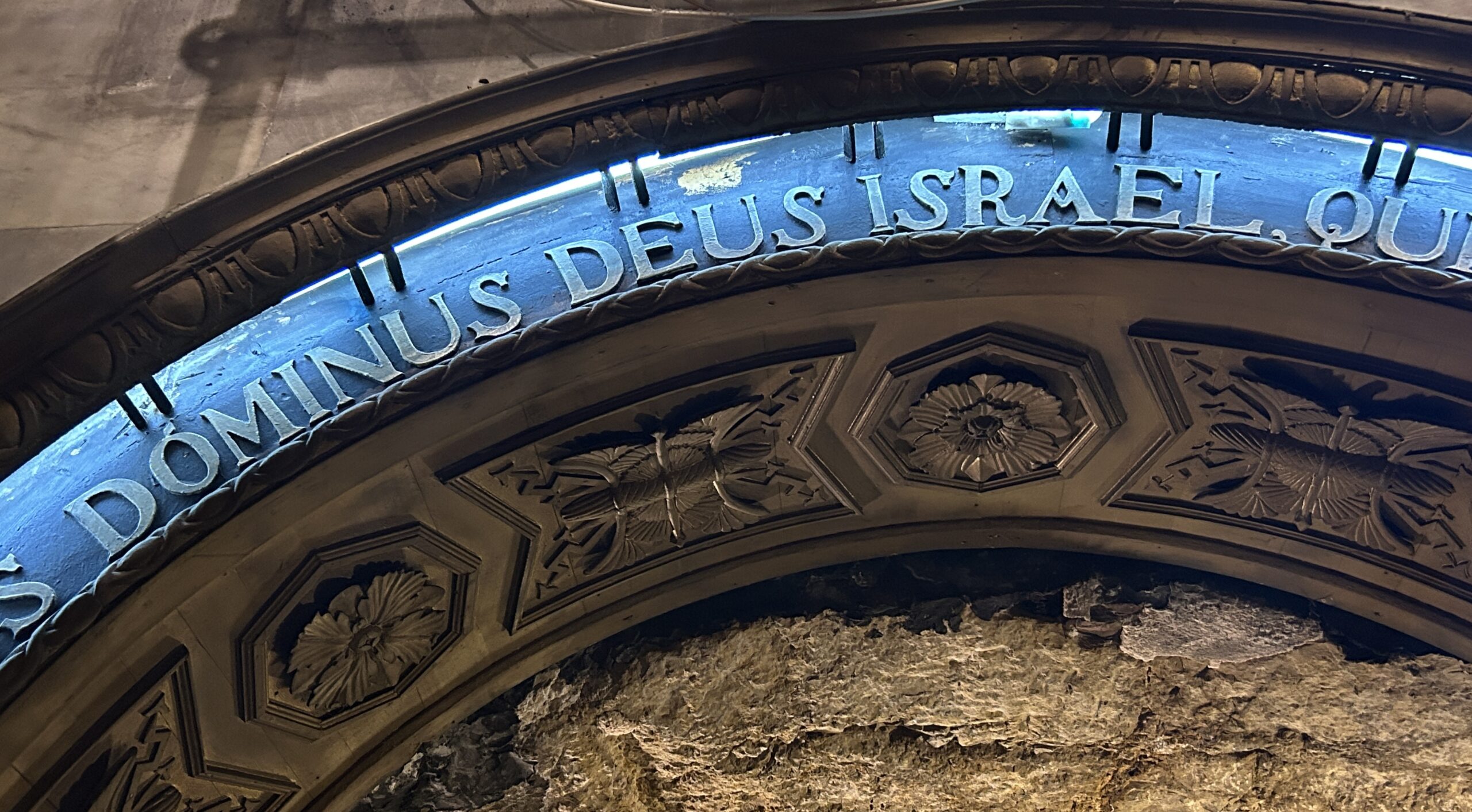
One of the hazards in growing up in a Protestant nation like the USA is that our theology is suffused with dispensationalism and odd evangelical movies. Because of this, many American Christians (including Catholics) picture Jesus as a hippie with no concern for the moral law.
The Pharisees, on the other hand, are portrayed as the people of the First Century in Israel who were overly-concerned with the Commandments and the Jewish law. Indeed, many Christian movies make Jesus out to be the beatnik who dissolved the moral law while the Pharisees were not only hypocrites, but even bad for thinking the Commandments mattered.
The Church Fathers, however, paint a very different picture. As we will see from Scripture and the Fathers below, the Pharisees were not only hypocrites—they didn’t even take the Jewish law seriously.
Firstly, let us remember what Our Lord said: Do not think that I have come to abolish the Law or the Prophets; I have not come to abolish them but to fulfill them. For truly, I say to you, until heaven and earth pass away, not an iota, not a dot, will pass from the Law until all is accomplished.—Mt 5:17-18. Thus, the New Testament fulfills the Old Testament without negating it.
Secondly, let us remember how many times the Pharisees broke not only the New Law, but even the Old Law in the New Testament. For example, even the Mishnah held that no capital trial could take place at night. And yet, such a travesty is exactly what the Jewish religious executed against Christ in a nocturnal kangaroo-court: And they led Jesus to the high priest. And all the chief priests and the elders and the scribes came together. And Peter had followed Him at a distance, right into the courtyard of the high priest. And he was sitting with the guards and warming himself at the fire.—Mk 14:53-54.
We are currently in the Octave of St. John the Baptist in the pre-1955 calendar of the Roman liturgy. St. John the Baptist was a Jew, and yet he had these choice words about his own religious leaders, the Pharisees and Sadducees: You brood of vipers! Who warned you to flee from the wrath to come? Bear fruit in keeping with repentance.—Mt 3:7.
Thus, the Pharisees not only rejected the law of the New Testament, but they even rejected the Old Testament. Again, this is very different from the American Zionistic view of Jesus and the Pharisees.
Yesterday, on the Feast of St. John the Baptist, we read these words in the ancient Roman Breviary:
But as touching this, that St. John the Baptist prophesied while yet in the hidden depths of his mother’s womb, and while himself lightless bore testimony to the truth, we are to understand it as a figure how that while himself wrapped round with the veil and carnal ordinances of the letter, he by the spirit preached unto the world a Redeemer, and testified that Jesus is our Lord even while for himself, working under the law, the birth of the new dispensation was still in the womb of the future, and not come to day. The Jews were estranged from the womb, that is from the Law, that womb heavy with the Christ Who was to be; they went astray from the belly, speaking lies (Ps. lvii. 4) and therefore John came for a witness, to bear witness of the Light, that all men through him might believe.—St. Augustine.
Notice above that St. Augustine says the religious leaders of the day were “estranged from the womb, that is the Law.” This means that the Pharisees did not care one iota for God’s law, even as given in the Old Testament even before we get to the Beatitudes of the New Testament. It was all charlatan show for the religious leaders of First Century Israel. Yet such a fact is obviously very different from the American Zionistic view. Such movies portray Christ as the hippie who loves relationship at the price of rejecting religion, while the Pharisees reject relationship and embrace religion.
Obviously, Christ wants us in relationship with Him and we are called to keep the Commandments: If you love Me, you will keep My commandments.—John 14:15.
The false-dichotomy created between love and commandments actually precedes 19th century dispensationalism. All of these errors go back to the 16th century Martin Luther. As most of you know, Martin Luther struggled with scrupulosity. Yet, he threw the pendulum hard to the other side. In rejecting excessive concern for the law of God, Luther even threw out the Commandments.
Thus, in rejecting the law of God, Luther projected upon Christ Himself certain false doctrines of once-saved-always-saved and the notion that deeds do not weigh into one’s own particular judgment. Hence, this was the proto-hippie movement against what was made to be cold-cut religion in the hierarchical Catholic Church. The outcome of this in the Protestant mind is that even good Popes and Cardinals over the last five centuries get easily compared to the Pharisees.
Again, St. John the Baptist puts an end to such a silly modern myth. The Baptist told the Jews to hold to God’s law, even in a specific manner, according to their state in life: Tax collectors also came to be baptized and said to him, “Teacher, what shall we do?” And he said to them, “Collect no more than you are authorized to do.” Soldiers also asked him, “And we, what shall we do?” And he said to them, “Do not extort money from anyone by threats or by false accusation, and be content with your wages.”—Lk 3:12-14.
Remember there also was a rich young man who came to Christ Himself, asking what one must do to be saved. Notice that Christ did not say “Oh, just have warm feelings about me as your fellow free-spirit, and then all will be well regardless of the Commandments.” Rather, Christ’s answer about salvation redounds to keeping the Ten Commandments: Why do you ask me about what is good? There is only One Who is good. If you would enter life, keep the commandments.—Mt 19:17.
Yet, some Protestants even today would reply to the above quote by saying: “Yes, but that was before the Resurrection of Christ, so even He was speaking under the Old Law. The New Law does not hold to the Commandments.”
Well, fine, then let’s see what even St. Paul says after the Resurrection of Christ about keeping the Commandments:
Or do you not know that the unrighteous will not inherit the kingdom of God? Do not be deceived: neither the sexually immoral, nor idolaters, nor adulterers, nor men who practice homosexuality, nor thieves, nor the greedy, nor drunkards, nor revilers, nor swindlers will inherit the kingdom of God. And such were some of you. But you were washed, you were sanctified, you were justified in the name of the Lord Jesus Christ and by the Spirit of our God.—1 Cor 6:9-11.
Finally, let’s go back to St. John the Baptist briefly since we are in his Octave. Notice again that St. John held to the law of God and yet, the Pharisees did not. We’re not just talking the New Testament that the Pharisees rejected. The Pharisees rejected both the Old Testament and the New Testament. Thus, there is no contradiction for Apostolic Catholics maintaining a relationship with Christ, and keeping the Commandments. So also, there is no contradiction in keeping to the Gospel and Canon Law.
Yet those in the Catholic Church today who break the law of the Gospel seem to be the same ones who break Canon Law. I showed this in my recent articles on bishops who send good priests to the psyche units. And yet we keep finding that those who truly keep the Gospel and the Commandments should have no fear of the true and authentic application of Canon Law in the Catholic Church. Thus, traditional Catholics should have no fear of the modernists, even if the latter control the buildings. It will all shake out in the end.
Thanks if you can donate to my online teaching ministry. I get health insurance from my diocese, but because I am no longer in parish life, all my income comes from readers like you and benefactors who support my life of prayer, study and evangelization.