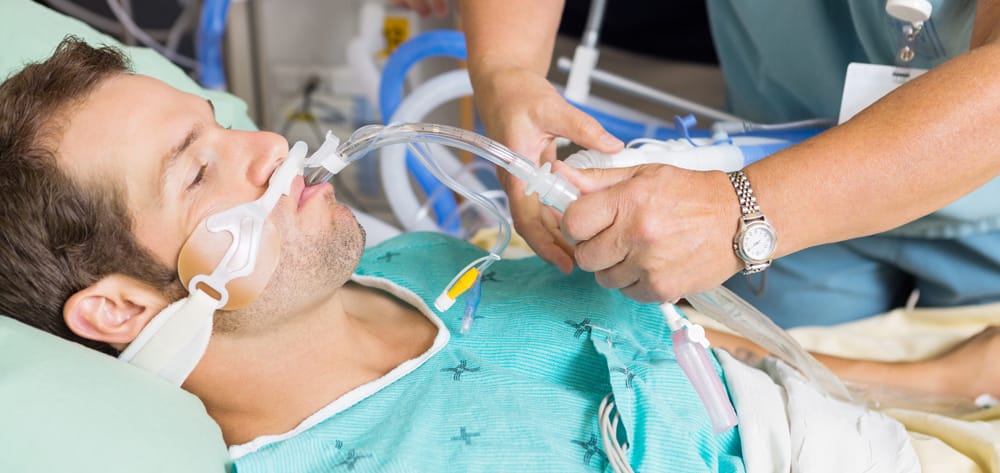
p/c American Nurse Journal.
What does the Catholic Church teach about DNRs and Ventilators?
I have had an article go viral recently on the topic of bioethics. Many in the pro-death world were shocked by my words and tried to counter me. Such people were easy to disprove because I sourced secular links into my articles, showing what even non-Christian surgeons were admitting about euthanasia.
On the other hand, some people in the pro-life world misunderstood the difference between ordinary care (required by the Catholic Church) and extraordinary care (not always required by the Catholic Church because it’s often disproportionate to what can be accomplished.) Their over-reaction in going even beyond me in bioethical stringency was out of well-placed zeal. So, I don’t blame them for doing this in a world where we traditional Catholics are always swimming upstream. However, we have to delineate between ordinary care and extraordinary care, or people will dismiss ordinary care assertions when we discuss Catholic bioethics with them.
The two most common ways of euthanasia that I have seen as a paramedic and a priest have been overdosing others on narcotics and starvation. Obviously, the Catholic Church allows anesthesia for surgery. This is in reference to acute medical cases, of course. But for chronic or longterm patients, while narcotics are indeed allowed for pain-management, they may not be used to make the patient unconscious. This is because “unconscious” for the long-term patient is a few milligrams away from respiratory arrest, which is a few milligrams away from cardiac arrest… which is death. Hence, narcotics can cause euthanasia. So, they can be used, but not to kill someone.
The saints say that hell is permitted to send its worst temptations to despair on the death bed. Thus, the dying person needs as close to full-access to his or her intellect to be making acts of faith and hope and love towards the end. Excessive narcotics or sedatives can impede this. This may be surprising for many “modernist Catholics” who put a hyper-emphasis on the sacraments. Such people need to realize that extreme-unction is a good start, but it doesn’t guarantee you will continue to make acts of faith and repentance up until the end. For that, you need good bioethics that prevent you from being out of your mind at the end. At least, we’re called to do our best on this. Obviously, some people die in medically-induced comas, and there’s usually no sin in that.
In 2007, the Vatican stated: “The administration of food and water even by artificial means is, in principle, an ordinary and proportionate means of preserving life.” That means fluid for a dying person is a non-negotiable when it comes to bioethics. Artificial nutrition and hydration is always required by even the lowest level of bioethical standards for a dying person in order for family and clinicians to avoid mortal sin. This means that any purposeful avoidance of an IV for a person who could take it would be tantamount to euthanasia.
And yes, I have heard every excuse in end of life care to avoid this: “Well, fluid will fill their lungs and it will speed up their death,” or “Well, fluid isn’t good for end-stage renal-failure and it will be a more painful passing,” or “Well, fluid is bad for congestive heart failure and it will kill them quicker.” Yes, there’s a small truth to all these cases. But parching someone to death is always a worse death than overworking someone’s kidneys a little.
To confirm this, I asked an exorcist trained in bioethics about this (who I trust very much) if an IV or a G-tube are always required for the dying patient who cannot eat. He told me that a G-tube is required if the patient is looking at long-term care (provided he does not have normal oral access to eating or drinking.) But he said an IV is required in 99% of the cases to provide ANH to a patient unable to eat, provided the body can indeed assimilate the fluids via IV.
Thus, starvation must be stopped by family members as much as possible. Recently, a donor asked me if starvation is really such a bad death. I simply responded: “Yes, this is why the Nazis tried to kill St. Maximilian Kolbe in the starvation bunker. They knew it was about the most painful death possible.” (I use the word “attempted” because God obviously kept the saint alive in the starvation bunker until the Nazis injected his veins with carbolic acid because the man simply wouldn’t die.)
I have covered all this before on what is required.
Today, I want to discuss two items in end-of-life care that are not always required. So, I am going to discuss two topics that even good pro-lifers frequently get wrong. Good Catholics go overboard (just a little bit) in pushing the pendulum so hard against the pro-death clinicians who surround us. Again, I bless this excessive zeal, but we must remember that we Catholic bioethicists remain more believable when we recognize that we are only on this planet to be born into eternal life. Thus, not all life must be excessively prolonged.
There are many things not-required by the Catholic Church in end of life care, but here are two:
CPR: It surprises many people when I tell them the Catholic Church does not have a problem with a terminal cancer patient wearing a Do Not Resuscitate (DNR) necklace. On the other hand, there’s no sin in desiring full resuscitation (CPR) in your end of life decisions.
Ok, but then how is the previous paragraph not a contradiction? It’s because CPR is extraordinary care, meaning it’s good— but not always required. What many Americans do not understand (especially from all the movies we watch) is that CPR is technically only done on a dead body. Yes, breathing for someone with a bag-valve mask may be done on someone only in respiratory arrest (not full cardiac arrest.) But when you see emergency workers doing compressions to the chest, it means the patient’s heart has fully stopped—at least, if the clinicians actually know how to take a pulse!
I have done CPR many times in my life as a paramedic. I have put in intubation tubes hooked up to bag-valve masks which later got connected to a ventilator in the hospital. I have shocked people with 300 Joules whose hearts were fibrillating. Some of these patients I got back and they lived. Some didn’t. They remained dead. (Notice I did not say “They died on me,” but “remained dead.”) Again, CPR is only done on a dead body.
So, when people are doing compressions on the chest of a dead person, often breaking ribs, we must realize that this is extraordinary care that cannot always be required by the Catholic Church for someone who simply wants to die peacefully at home after a long battle with some terminal illness.
Again, CPR is great! I have no regrets in having done it in my past to save lives as a paramedic. But others dying at home of terminal cancer can wear DNR bracelets while incurring no sin. In that case, I had no problem as a paramedic in refraining from starting compressions, shocking them, shooting them with epinephrine and doing other invasive procedures like intubation tubes. None of these aggressive procedures are required by the Catholic Church to be done on someone who is dying peacefully at home after a long battle with a terminal illness.
Or, you can put it in your advanced-directives to get resuscitated, if you want. No problem either way. No sin either way. Such is the case with extraordinary care in bioethics.
Ventilators) This is another item not always required by the ordinary means defined in Catholic bioethics. A ventilator is a breathing machine, usually found in a hospital. They are frequently found in ICUs or Critical Care units, connected to patients who are intubated. Most of these patients are in medically-induced comas until they recover from their illness or injury. Ventilators, or breathing machines, are amazing inventions that have saved millions of lives. Or more accurately, ventilators have kept millions of people alive while the body was still trying to heal itself.
Because ventilators are invasive and aggressive medical procedures (and because they are not found in most towns across the seven continents on this blue planet) then they must be considered extraordinary care. In other words, they are suggested but not required care according to the Catholic Church, when attempting to save the life of a critical patient.
Or, better put: A Catholic patient is not required to be on a ventilator for, say, a year. In fact, that would be a horrible decision.
How long then should you go on a ventilator before it’s time to “pull the plug”?
To answer this, we have to back up into the definition again of ordinary care versus ordinary care. For concerns of ordinary care (eg artificial nutrition and hydration) it would obviously be a mortal sin for any family member to even mildly participate in helping any clinician starve or parch that family member to death. Thus, ANH is always required, regardless of circumstances, as stated in the first half of this article.
ANH is obviously required whether the dying person is a professional soccer player or Downs Syndrome boy. This is true whether we’re taking an otherwise-healthy 15 year old girl after a car accident or a 99 year old man dying a natural death. In other words, when dealing in the realm of “ordinary care” there is no wiggle-room for heretics of moral theology.
Common heretical phrases justify euthanasia under pretext of “acting for the greater good of the family” or “dying with dignity” when choosing to starve someone to death. Clearly, all of these modernist catch-phrases redound to the ever-pervasive moral heresy among the modernists of the end justifying the means. Every time there is such a proportionalistic approach to bioethics, it is a mortal sin, at least when avoiding ordinary care.
However, when dealing in the realm of extraordinary care, one can indeed use proportionalistic ethics. For example, when assessing how long someone should be on a ventilator, one can weigh proportionalistic aspects of bioethics. What are these “proportionalistic aspects?” These would include chances of success, viability, predicted outcomes, patient wishes, family wishes, the pain of a prolonged life and even finances of the family and/or the hospital.
Basically, as long as eugenics are not involved (valuing one person over another due to disability) decisions on extraordinary care like a ventilator can be based on the many factors that will affect the family and the patient.
For example, I have a friend who is a nurse-practitioner. She is my medical durable power of attorney if I end up in a coma. We have discussed it and she will probably keep me on a ventilator for two weeks following trauma but perhaps one month following a medical insult against my body. She has the same bioethics as me, so I’m going to let her choose that quarterback’s fourth-quarter audible, so to speak, if I end up in an ICU.
One reason why I suggested in past articles that you obtain a medical power of attorney instead of advanced directives is because there are always a thousand factors to weigh. Hence, use of a a ventilator has no “easy answer” even for so-called “rigorists” in Catholic bioethics like me. The point is that she knows she can weigh a lot of factors if I end up on a ventilator in an ICU.
Remember that Terry Schiavo did not die by her husband “pulling the plug” on a breathing machine. In 2005, he got the court order allowing him to dehydrate her to death. Yes, you read that correctly, she was dehydrated to death. As I mentioned above, this is one of the most cruel deaths a person can endure. And this type of murder is happening today not only at the hands of thousands of secular hospices across the land, but also at the hands of numerous so-called “Catholic hospices.”
As I have written before, an aggressive hospice (who I didn’t call) even tried to kill my own mother when she was dying. They did get to her, for she died at 45 pounds. This was despite my own semi-successful attempts at getting boutique IV companies in there for fluid, but no one else would help. So, please understand that hospice has one goal, and one goal only: euthanasia, as seen in an article titled Palliative Care: The New Stealth Euthanasia.
But back to advanced machines: I understand why many pro-lifers think everyone has to be on a ventilator indefinitely if we’re going to be considered “pro-life Catholics.” But what they don’t understand is that the ventilator is breathing for a person already dying. Thus, “pulling the plug” sounds horrible (and it is, horrible, at least when eugenics or real euthanasia is involved) but “pulling the plug” is often just refraining from excessively invasive and aggressive care not even required by the Catholic Church’s high bioethical standards. “Pulling the plug” is often just allowing a person who has fought the valiant fight to finally enter a peaceful and natural death.
If we were not made for this earth (and we were not, for we were truly made for heaven!) then unjustly prolonging a person’s life with million-dollar machines that cost a few thousand dollars a day to run is nothing short of that secular holy grail of immortality on earth that those adrenochrome-drinking globalists seek in order to never die. Such a view of life is obviously not Catholic. Although we know we will regain our bodies at the Resurrection of the Dead, we still admit that here on earth “it is dying that we are born to eternal life.”
Maybe the best way to see a breathing machine goes like this: Refraining from a ventilator never kills a person. Why? Because the injury or illness in the body of the dying person is ultimately what leads it to respiratory arrest. You see, if you “pull the plug” on the ventilator on a perfectly healthy person, he or she will immediately start breathing on their own! (This is true, provided they’re not in a medically-induced coma, at least.) Thus, refraining from a ventilator technically can’t kill anyone.
Don’t get me wrong—ventilators are amazing products of the powerful brains that God has given to man. They can and should be used as much as possible to save lives. But there comes a point where the use of them is disproportionate and burdensome to both the patient and the family. At that point, not even the Catholic Church has a problem with “pulling the plug,” even though that line has been associated with euthanasia for years for some reason.
In summary, we must always, always, always avoid starving our loved ones to death, or overdosing them to death with narcotics. I have written about that many times. I have spoken on videos and podcasts about that. Again, starvation is the most painful and inhumane way of killing a parent or grandparent around, even when they are too weak to cry out, as was my own mother.
So, what is new in my article today is this: You don’t have to go above-and-beyond in treatments for the terminally ill with rib-cracking chest compressions (something prevented in wearing a DNR to avoid CPR) or keep a person on a painful ventilator for six months. These are just two examples of several I could have given on what is not required in Catholic end-of-life care.
This is especially true when such a sick loved-one is [most likely] living in sanctifying grace, receiving the sacraments and is prepped for their long-battle with a terminal illness to end in a peaceful death surrounded by family and clergy—not clinicians or “breathing robots.” Such is a coherent and peaceful way to usher our loved ones into eternal life.
Thanks if you can donate to my online teaching ministry. I get health insurance from my diocese, but because I am no longer in parish life, all my income comes from readers like you and benefactors who support my life of prayer, study and evangelization.