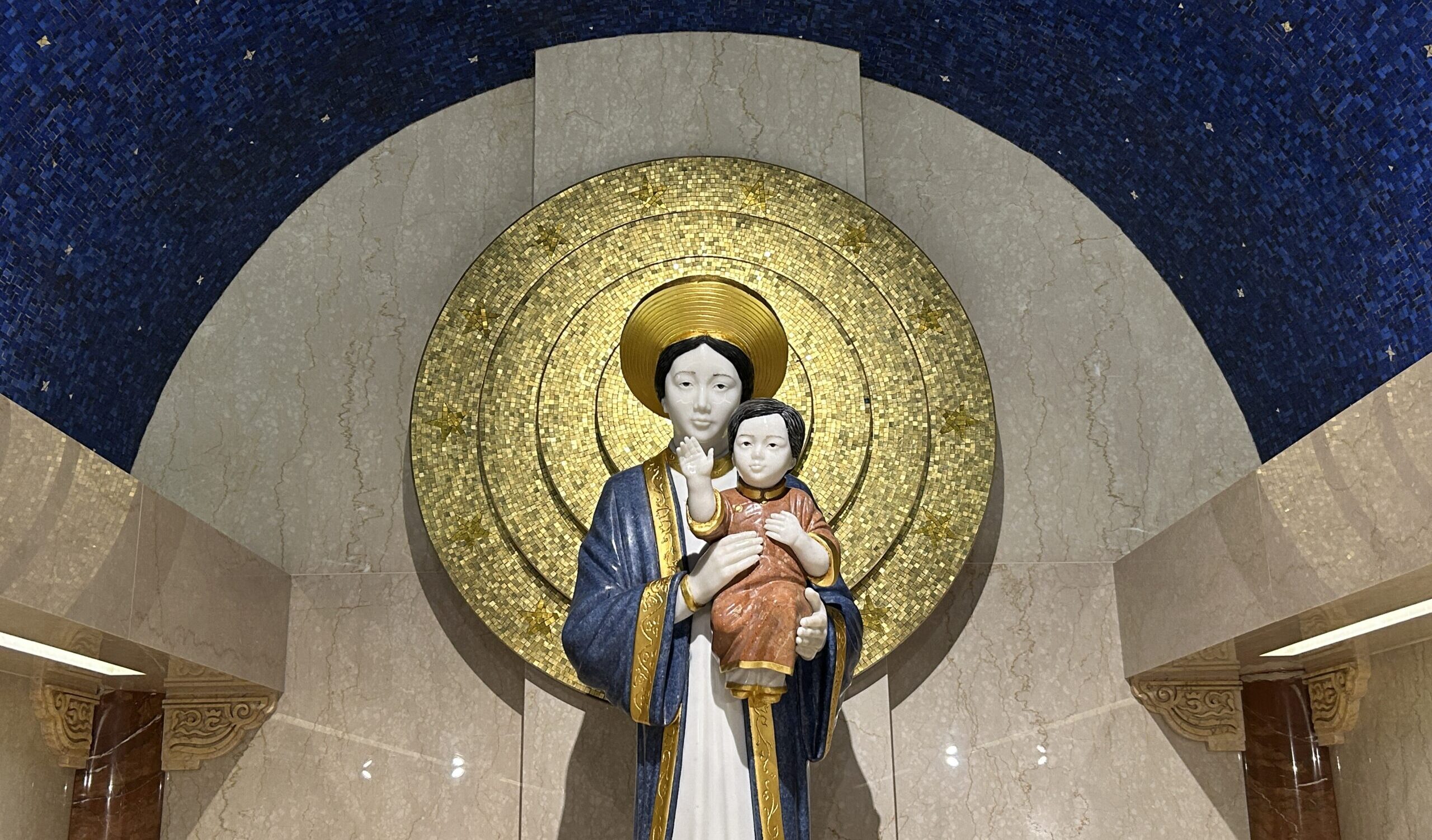
Did Mary exist before time? No… But the blueprint for her Immaculate body and soul was planned above all time in the mind of God.
Some people new to the Traditional Latin Mass (TLM) might be surprised that the Old Testament reading in many of the Masses in honor of Our Lady seems to imply she was pre-existent. The Latin reads: Ab initio et ante sæcula creata sum, et usque ad futurum sæculum non desinam, et in habitatione sancta coram ipso ministravi.—Ecc 24:14.
Or, in English: From the beginning, and before the world, was I created, and unto the world to come I shall not cease to be, and in the holy dwelling place I have ministered before him.—Sirach 14:14.
First, we must understand that these Masses are in honor of Our Lady. We Catholics do not sacrifice to Mary. Why? Because only God is the object of our sacrifice. And because the Son of God descends upon our altars as Catholic priests, and because the Holy Mass is the re-presentation of Calvary, we can say that we adore God alone at the Holy Sacrifice of the Mass.
But every Mass, in some sense, is offered in honor of all the saints and angels. Of course, the one who deserves our honor the most is the Holy Theotokos. Traditionally, any Saturday Mass that was not a Second or First Class Feast (Double in antiquity or Feast/Solemnity in the new calendar) could be offered in honor of Our Lady.
Again, in the TLMs of Saturday, the Church mysteriously applied this line to the Mother of God: From the beginning, and before the world, was I created, and unto the world to come I shall not cease to be. But if this is truly applied to Mary (and it is) then the problem is that it sounds like Mary was pre-existent… like Christ.
Catholic theology firmly tells us that Mary was not pre-existent. She is a creature. Only the Creator (the Holy Trinity) fully exists in eternity. We cannot even say that God existed “before” time because God invented time, meaning the word “before” fails to even grasp the absolute eternity of God.
Here is where we look to philosophy to help with the problem at hand, even before we look to theology. The formal cause of something is the design. Because God is in eternity, we can say that every single human being and angel existed in His mind in eternity “before” (for lack of a better term) all of time. But such creatures only existed as a blueprint in the mind of God, not in their physical bodies yet. This should be obvious to anyone who understands the basics of eternity being outside time.
Now we have to add some theology to the philosophy. Obviously, Christ is God the Son. That means He is the Eternal Word who is God Himself. Christ created (with God the Father and God the Holy Spirit) the human soul of Jesus and the human body of Jesus. In other words, Jesus (as God) created his own soul and body (in His humanity.) Yes, Jesus is Creator and creature.
As I wrote recently, the Church Fathers insist that while Christ was 100% human, the center of His responsibility was Divine. Thus, Christ is a Divine Person Who is hypostatically united forever (at least from the point of the Incarnation onwards) to His Sacred Humanity. So, even though Christ has a human body and a human soul, He is exclusively a Divine Person.
Now, the second most perfect body and soul existing as a formal cause (design in the mind of God) was that of the Immaculate Virgin Mary. But Mary is not a divine person. She is a human person. This is why we can say that as far as human persons are concerned, she was given the most perfect and immaculate soul and body of any human person. As the Eastern Divine Liturgy proclaims, she is “higher than the Seraphim, more glorious than the Cherubim!”
Again, Sirach reads: From the beginning, and before the world, was I created, and unto the world to come I shall not cease to be... Yes, such a stunning line, Ab initio (From the Beginning…) means she was planned by God in a manner unlike that of any creature—saint or angel.
So, if purity were to be the color white, then Mary is not simply the most white of all saints. She is whiteness itself. This is why St. Maximilian Kolbe wrote:
“At Lourdes, the Immaculate Virgin replied to St. Bernadette: ‘I am the Immaculate Conception.’ With these words she clearly stated the fact that she is not only immaculately conceived, but is the Immaculate Conception. Similarly, a white thing is something different from being-white itself; a perfect thing is something different from perfection itself. When God spoke about Himself, He said to Moses, ‘I Am Who I Am,’ that is: it belongs to my essence that I always have my being in and of Myself, without beginning. In contrast, the Immaculate Virgin has her beginning in God; she is a creature, is a conception. And yet she is the Immaculate Conception.”—St. Maximilian Kolbe in Miles Immaculatæ p. 8-9.
Or, consider the stunning words of St. Bonaventure who wrote: “God could make a bigger world or a wider sky, but He could not raise a pure creature higher than Mary.”
Think about that for a minute. Have you ever read another quote in all of history where a saint seems to put a limit on God? Ah, but St. Bonaventure is not putting a limit on God. The great Franciscan saint and doctor of the Church is simply saying that God could not have made a purer Immaculate Conception than the Immaculate Virgin Mary…because… in making Mary… God truly outdid Himself.
Blessed upcoming Feast (and Month) of the Immaculate Heart of Mary!