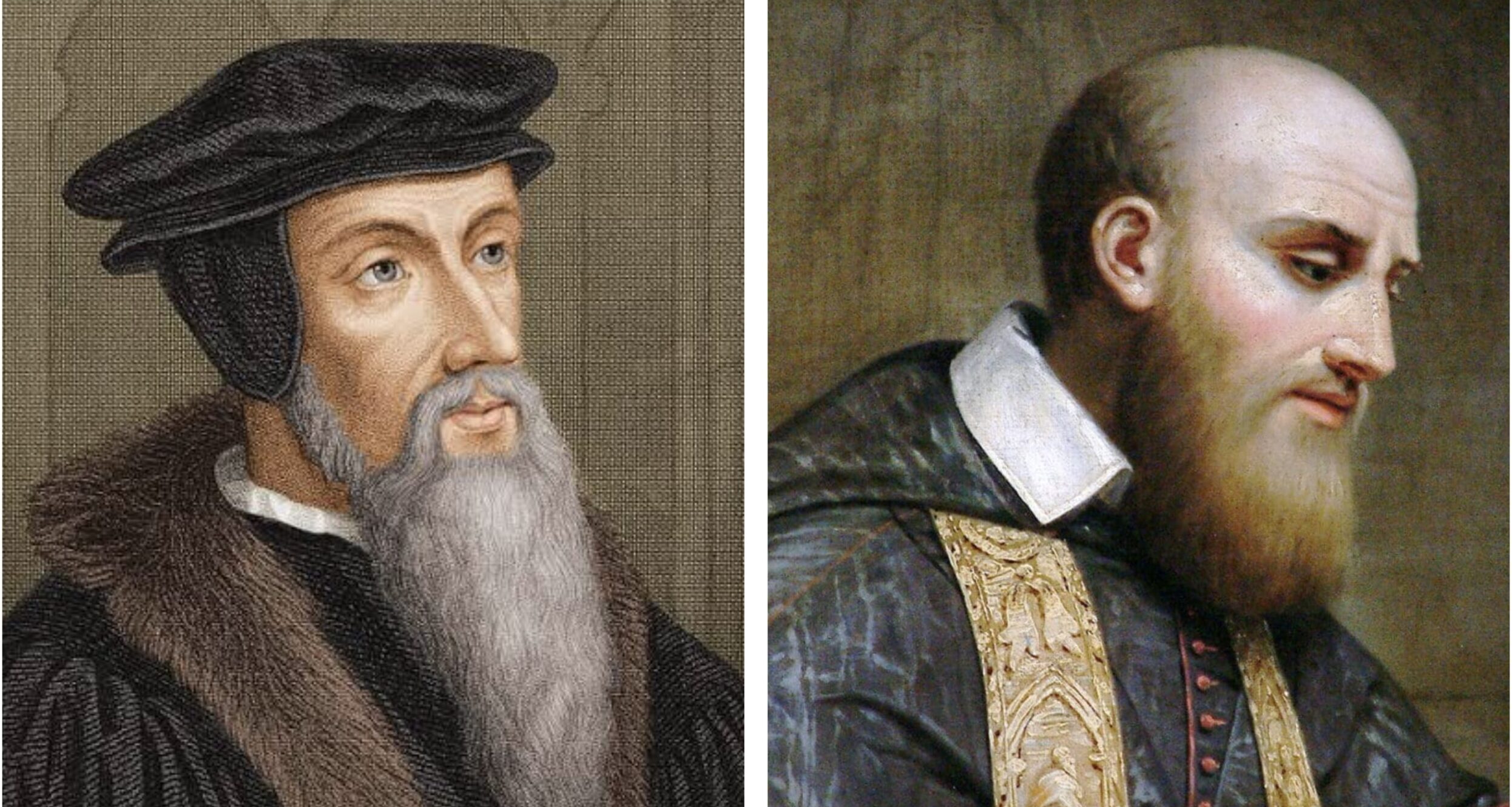
The top left is John Calvin, the theological father of modern Presbyterianism who believed in Double-Predestination (the notion that God creates some people for heaven and God creates others for hell.) The top right is St. Francis De Sales, a Catholic saint and doctor of the Church. Both said a lot about pre-destination.
Granted, we Catholics have some Church Fathers who seemed to have flirted with Double Pre-Destination even before John Calvin did, so it’s not a clear-cut topic. But ultimately, St. Francis De Sales navigated the true way between the Fathers and Common-Sense on God’s mercy. Fr. Ludwig Ott has a book titled Fundamentals of Catholic Dogma in which he beautifully quotes St. Francis De Sales. I highly suggest you read it.
Recently, I received an email from a young man struggling with the topic of predestination. Although I’m not going to give long quotes from St. Francis De Sales, I can say that St. Francis De Sales is the one who helped me most through my own theological struggles on this topic. Hopefully, you can see strands of his thought in my letter below on this delicate topic. I replied:
Dear A,
Ave Maria.
I really struggled with the Catholic Church’s teaching on predestination when I was your age, too.
Double predestination is that God predestined some to heaven and some to hell. St. Augustine may have believed in this.
But I think St. Francis De Sales ironed it out a bit better. Basically, God is in eternity, so he has foreknowledge (really this is knowledge outside of time as He is in eternity) who is saved and who is not.
The elect have received efficient grace. Often, these are saints who have received tremendous amounts of grace. They still had free will, but maybe we could say it would have been “harder” so to speak for them to reject this efficient grace.
However, and here’s the key to how we differ from Calvinists: The infallible Councils of the Catholic Church (as well as St. Francis De Sales) teach that every person has received sufficient grace to be saved. This includes even those who went to hell. They may not have received as much grace as Catholics who made it to high levels in heaven (again efficient grace) but they did receive sufficient grace. Those who went to hell, despite sufficient grace, did so via their own free will. Thus, I think it’s pretty safe to say we as Catholics reject double predestination.
The reason many saints didn’t want to simply put everything on man’s free will is because we never want to ascribe to God a passive role in man’s salvation. On the other hand, we know that God wills all men to be saved (1 Tim 2:4.) Thus, free will of man plays a very big roll in his salvation or rejection of salvation.
Because that balance between God’s sovereignty and man’s free-will is so difficult to comprehend before the General Judgment, some saints (like St. Ignatius of Loyola) advise us it’s just not good to spend much time thinking about predestination. I agree with him, because it’s very easy to then despair of salvation for some and too easy to lean towards presumption at other times in our life.
So, while we as Catholics do believe in predestination, it’s better to focus on the predestination of certain saints like the Blessed Virgin Mary. And then to also realize the souls in hell did have sufficient grace to be saved, but rejected it. Why then did God create such reprobate souls knowing they would go to hell? That’s a mystery we won’t fully understand until the General Judgment. But we do know that God at some level wanted them in heaven. Christ died not only for the elect, but for the whole world (1 John 2:2)
AMDG,
Fr. David