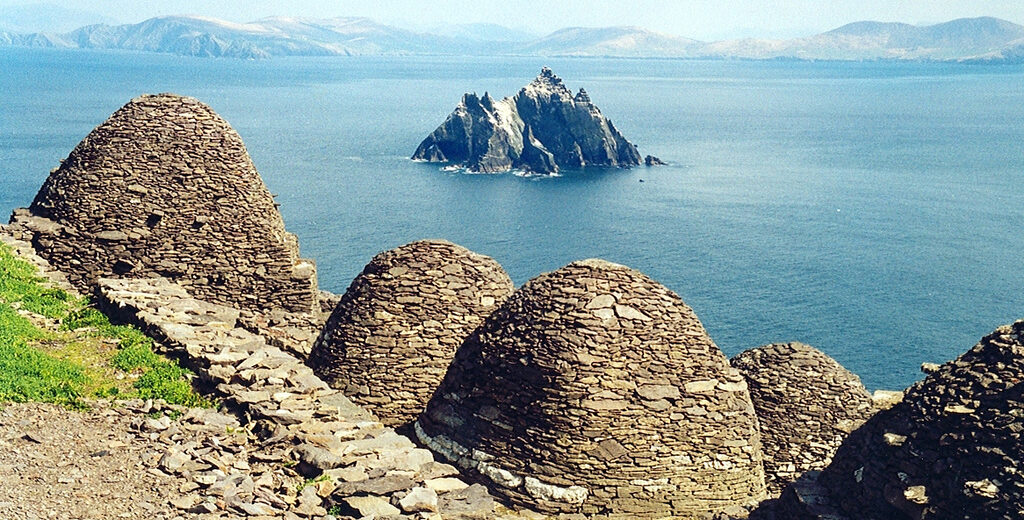
At the farthest southwest reach of County Kerry (already the most southwest county in Ireland) jut-out into the Atlantic Ocean two crags collectively called Skellig Michael (see above, p/c Arian Zwegers) so remote and mysterious that Star Wars makers filmed parts of The Force Awakens and The Last Jedi there.
But more fascinating than this is the fact that the real Christian Jedi—some of the most ascetical monks in all of Catholic history—built their beehive dwellings on these remote islands between the 6th and 8th century. The beehive huts of Catholic monks are called clocháin in Irish and bear a striking resemblance to the beehive huts of the Desert Fathers of Egypt.
Notice this article is not about Egyptian pagan influence upon the Irish, but Egyptian Christian influence upon early Irish Catholics.
Egyptian Christian monastic life was founded by St. Antony of the Desert. (The definitive biography on his life is still the one written by St. Athanasius of Alexandria.) The Egyptian desert monks began their ascetical struggles in the 3rd century. So, how could they have influenced Celtic monks 4,000 km away and four centuries later?
St. John Cassian (360-435AD) was a Slavik monk who learned monasticism in Bethlehem and the Scete of Egypt. Around the year 400, he fled the desert due to Christological debates and went to St. John Chrysostom in Constantinople who ordained him. But in 404, when St. John Chyrostom was sent into exile, Cassian subsequently went to the Pope in Rome who allowed him to establish the Egyptian practices of the Desert Fathers in a monastery in France.
Perhaps a couple hundred years later, after St. Patrick had already brought the faith to Ireland in the 5th century, Irish monks then learned this way of extreme Egyptian asceticism in France, bringing the practices back to Ireland.
Of course, some people at this point would say, “Monastic life developed everywhere. What is the big deal?” Well, the big deal is that the two most extreme sets of monks in all of Christian history conglomerated in Egypt and Ireland. The big deal is that they have an overlap of very similar practices which are not found in other parts of Western Monasticism.
For example, besides the unique beehive huts above, both Egyptians and Irish practiced a form of individual monasticism. Yes, they came together for Liturgy and Psalms, but they lived alone. This is unlike Benedictine monasticism that almost always promoted communal living.
Also, both lived a way of constant prayer. While the Egyptian monks probably practiced some form of the Jesus Prayer (Lord Jesus Christ, Son of the Living God, have mercy on me a sinner) the Irish monks constantly prayed their Psalms. In fact, Irish monks would pray all 150 Psalms a day—often saying all of them in the morning while submerged up to their chests in the freezing cold water of the Atlantic Ocean! (Do you see why I call them “the Jedi” of the early Church?)
The extreme fasting of the Celts may be linked back to the desert fathers. Here are the seven levels of the Egyptian Desert Fathers’ perpetual fast that they challenged themselves to accomplish bit-by-bit:
A: Carnivores, who eat meat (even occasionally, not exclusively.) These are in the lowest degree of fasting, even if they sometimes restrain themselves from food. They are never able to advance in prayer.
B: Lacto-vegetarians, who never eat meat, but only milk, cheese, eggs and all kinds of boiled vegetables. These are in the second degree of fasting, which is kept by Monks in coenobitic Monasteries and, very rarely, by laymen.
C: Vegetarians… who eat only vegetables and boiled or raw legumes. This arrangement forms the third degree of fasting, and the most zealous monks of the common life keep it.
D: Fruit-Eaters those who eat bread and uncooked fruits once a day, without otherwise ever tasting food. He who attains this degree of fasting is able to master his body and thoughts without difficulty and can advance rapidly on the path of prayer.
E: Cereal-Eaters (not Cap’n Crunch) comprise the fifth degree of fasting. To this degree belong monks – especially hesycasts and desert-dwellers – who eat once a day only black bread, cereals, and soaked grains of wheat, corn, millet, lentils, beans, peas, etc.
F: Dry Food is the sixth degree of monastic fasting, which is usually attained only by the most zealous desert dwellers. Those who live in this harsh asceticism eat only dried bread soaked in water, with salt or a little vinegar, once a day and by measure. This is how the hesycasts of the Nile valley lived.
G: Divine Food or manna, is the last and highest degree of monastic fasting, which is attained by very few ascetics after prolonged asceticism, being strengthened by the grace of the Holy Spirit. These are satisfied with the Most Pure Mysteries alone, that is, with the Body and Blood of Christ, which they receive only once or twice a week, without tasting anything else but water only.
One monk wrote: “After difficult temptations and asceticism, and by the Grace of God, I have come to be satisfied with the Most Pure Mysteries alone, and no longer feel hunger, or have need of bread or vegetables…”