As you know, one of the most common complaints against my life is that “hermits shouldn’t travel.” Besides the fact that my rule of life has 20 days contemplative and 10 days active life approved every month by my superiors, it’s important to look at Catholic Church history on the life of contemplatives to see if there’s any precedent to my way of life. We’re going to go look way back to the First Millennium of Catholicism to the country whence my ancestors come: Ireland.
Raymond O’Flynn in Frank Sheed’s book The Saints Are Not Sad wrote about an army of Irish and Scottish monks that left their monasteries and evangelized Europe. St. Columba (or in Irish, St. Columcille, pronounced kolum-killa) was a 6th century Irish abbot who went to Scotland, using his original Irish monastery as the launching pad for spreading the faith:
“Unlike the homes of St. Benedict, an Irish monastery was never a mere asylum from the tumult of the world. Rather it was a citadel, a base of operations from which the ‘soldier of Christ’ (Adamnan’s expression) could conduct his campaign in the surrounding territory. According to this native conception, Iona was meant to be a strategic point to preserve the Faith among the Scots of Dalriada, and to carry it to the utmost confines of the Picts.”
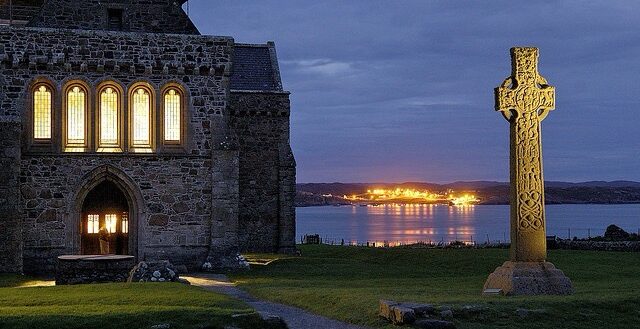
Notice the Irish couldn’t stay still. O’Flynn rightly recognizes the stability of the Benedictines in Italy, but the Irish often saw their monasteries and hermitages as “citadels” or even a “base of operations” full of books to not only keep the faith, but also transmit the faith. St. Columba founded the above abbey (see featured image above) in Iona, Scotland.
For the Irish, anything that burns in the heart in regards to the Gospel of Jesus Christ has to be shared with others. Mr. O’Cahill describes how Irish monasticism in even the First Millennium of Catholicism boiled over in a general desire to reach many other peoples:
“At that period there was great missionary activity among the nations of Europe, and those familiar with ecclesiastical history know that Ireland—Insula Sanctorum—was foremost, aflame with apostolic zeal, her sons shrinking from no peril, by land or sea, in their labor for the salvation of souls…Men and women, inspired by the same ideal, were thronging to them until Ireland, loud with psalms, became a gigantic hive of religion whose members’ chief need was fresh fields to which they might bear their honeyed faith. It was a reversal of the Gospel state of things: harvesters were not lacking; the need was a new terrain where souls might be garnered for God.”
But some of these old-school Irish contemplatives went even further than Scotland. This might be shocking to some, but there is solid evidence that another 6th century Irish contemplative, St. Brendan the Navigator, brought the Catholic Faith to the Americas 1000 years before Christopher Columbus’ first missions!
Donal O’Cahill, in the same book quoted above, writes about St. Brendan the Navigator’s 6th century adventures:
“Ever since childhood he had seen it blaze a path of glory over the wastes to the unknown west. Since the world began that sight had stirred even the least imaginative among men and, inevitably, it filled with dreams of discovery the missionary soul of Brendan. There, to the west, might be the haven he was hoping for—a possible outlet for that surging tide of the missionary Gael… Some accounts place his landing in Newfoundland and others mention the Virginian Capes. While these are not authoritative, there is said to be proof in indigenous remains that Irishmen had settled in America centuries before the Spanish sighted its shore. It is said too the Darien Indians spoke a language akin to that of the primitive Irish, and that an eighth-century people in Florida were speaking the Irish tongue. Furthermore, the early Mexicans were undoubtedly acquainted with Christianity’s central truths…”