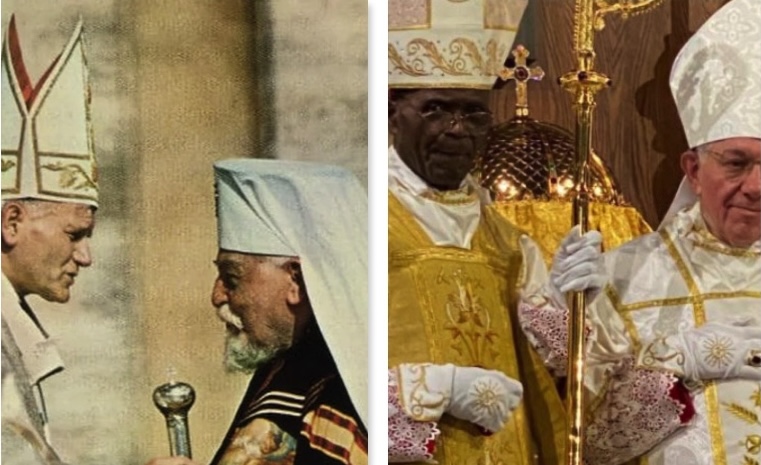
Above-left is Pope John Paul II with Cardinal Slipyj (p/c OnePeterFive) and above-right is Archbishop Telesphore George Mpundu with Bishop Anthony Ward (p/c Cathinfo.)
I was an EMT for two years and a paramedic for two years. A paramedic has about 10x the training of an EMT. An EMT does Basic Life Support (BLS) and a paramedic is authorized for pre-hospital Advanced Life Support (ALS.) One of the things I say looking back on that chapter of my life is this: “A good EMT follows the guidelines. But a good paramedic knows when to go above the guidelines.” Notice I call them “guidelines” instead of “rules” since breaking rules just makes you a rebel. Notice also I used the verb “goes above” instead of “breaking” since we are called to go above—not below—the basics of pre-hospital medical parameters.
In the military and law enforcement, this is called “exigent circumstances.” One definition I found online explains: “Exigent circumstances are emergency situations that required immediate action, allowing law enforcement to bypass the standard requirements.” St. Thomas Aquinas also has a term for this. It’s called “Epikeia.” I wrote a whole article on it here. The basics is that St. Thomas defines it as this: “On these and like cases it is bad to follow the law, and it is good to set aside the letter of the law and to follow the dictates of justice and the common good. This is the object of ‘epikeia’ which we call equity.”
Do you see the similarity between exigent circumstances and epikeia? The letter of the law is sidelined for the dictates of justice when you are trying to glorify God and save souls (or bodies.) As you know by now, a constant theme to my writing and podcasting is that common-sense always trumps legalism. Ironically, “liberal Catholics” have become the gnat-straining Pharisees who put canon-law loopholes ahead of the Gospel. That is why it is so ironic they label us traditional Catholics as “Pharisees.”
Recently, a bishop in my home state of Colorado named Bishop Anthony Ward was declared “ex-communicated” automatically (latæ sententiæ) by porn-writer Tucho Fernandez. This was because Ward was consecrated a bishop, but without permission from Rome. Catholic Herald reports: “Bishop Ward also confirmed that Archbishop Mpundu had conferred episcopal orders upon him last year, despite the community’s lack of canonical status and the automatic penalties attached to consecrating a bishop without papal mandate.” (See two men in top right picture.)
Was this justified due to St. Thomas’ epikeia in light of the Church crisis? Was this justified due to what military members call “exigent circumstances”? Let’s look at the answers to the right and left of me. First, to the right of me: 58-sedevax will say this was invalid due to Mpundu himself being ordained a bishop many years ago by another bishop who was not consecrated in the old rite. (If nothing else, they are consistent in their premises and conclusions.) Now to the left of me: Most neo-con non-trads (fans of Pope John Paul II) will say Bishop Ward was validly but illicitly consecrated a bishop due to it being against the wishes of the Vatican.
That latter group will look at the virtue of epikeia and say: “That looks like a clever way to be Protestant. If a bishop can disobey Rome to do whatever he wants, he is really no different from Martin Luther 500 years ago. Hiding disobedience under cover of advanced terms like ‘epikeia’ or ‘ecclesial exigent circumstances’ is just justification for having no chain of command within the Catholic Church.”
Fair enough. But then what do the neo-con non-trads do with Pope John Paul II himself? Do they know that both he and Cardinal Slipyj disobeyed the commands of Pope Paul VI in making priests and bishops? Their reason for disobedience—the necessity caused by communism behind the Iron Curtain in the 1970s. Dr. Kwasniewski at One Peter Five has an article titled Clandestine Ordinations Against Church Law: Lessons from Cardinal Wojtyła and Cardinal Slipyj. (See two men in top-left picture.)
First, Dr. K quotes George Wiegel’s biography on Wojtyła titled Witness to Hope:
Cardinal Wojtyła never doubted the good intentions of Paul VI in his Ostpolitik, and he certainly knew of the Pope’s personal torment, torn between his heart’s instinct to defend the persecuted Church and his mind’s judgment that he had to pursue the policy of salvare il salvabile [“to save what could be salvaged”]—which, as he once put it to Archbishop Casaroli, wasn’t a “policy of glory.” The archbishop of Kraków also believed he had an obligation to maintain solidarity with a persecuted and deeply wounded neighbor, the Church in Czechoslovakia, where the situation had deteriorated during the years of the new Vatican Ostpolitik… So Cardinal Wojtyła and one of his auxiliary bishops, Juliusz Groblicki, clandestinely ordained priests for service in Czechoslovakia, in spite of (or perhaps because of) the fact that the Holy See had forbidden underground bishops in that country to perform such ordinations… Cardinal Wojtyła did not inform the Holy See of these ordinations. He did not regard them as acts in defiance of Vatican policy, but as a duty to suffering fellow believers.
Cardinal Josyf Slipyj (1892–1984) went even further. Contrary to the will of Rome, he even ordained bishops because of what he thought was a state of necessity under a communist government. Even Fr. Raymond De Souza (hardly a traditionalist) somehow admits to a state of necessity in certain ecclesial decisions against the hierarchy:
In 1976, the head of the UGCC, Cardinal Josef Slipyj, living in exile in Rome after 18 years in the Soviet gulag, feared for the future of the UGCC. Would it have bishops to lead it, given that Slipyj himself was now over 80? So he ordained three bishops clandestinely, without the permission of the Holy Father, Blessed Paul VI. At the time, the Holy See followed a policy of non-assertiveness regarding the communist bloc; Paul VI would not give permission for the new bishops for fear of upsetting the Soviets. The consecration of bishops without a papal mandate is a very grave canonical crime, for which the penalty is excommunication. Blessed Paul VI—who likely knew, unofficially, what Slipyj had done—did not administer any penalties.
Why then was Archbishop Lefebvre declared “automatically excommunicated” for doing the same thing? Why then was Bishop Ward declared “automatically excommunicated” for receiving the same Holy Orders under a state of necessity?
Even if you do not like the SSPX’s view of “state of necessity” or “state of emergency” or “supplied jurisdiction” ecclesiology, you have to admit that darlings to the conservative movement, namely, Cardinal Slipyj and Cardinal Wojtyła did the same thing as Lefebvre in the 1970s. How ironic that John Paul II declared Lefebvre excommunicated for doing the same thing in the 1980s!
Of course, some readers might protest: “Yes, but communism is worse than modernism. Slipyj and Wojtyła disobeyed Rome because communism was a real threat. Lefebvre, Ward and Mpundu all disobeyed Rome due to their imaginary boogey man of modernism that they find under every rock.”
My reply should be obvious by now: Communism is Our Lady of Fatima’s dreaded “errors of Russia” inflicted upon the State. Modernism is Our Lady of Fatima’s dreaded “errors of Russia” inflicted upon the Church. Which is worse—totalitarianism inflicted upon the State, or totalitarianism inflicted upon the Church?
Obviously, we need to look to “ecclesial exigent circumstances” and “epikeia” in order to save souls in a Church crisis as severe as one where Rome is involved in open LGBT pilgrimages and Pachamama worship. Even the new 1983 Code of Canon Law finishes the current edition by the final canon in the code ending with this: “Salvation of souls is the supreme law of the Church.”